Determination of the Blaze Wavelength
It has long been known that diffraction gratings can, in certain configurations, concentrate a large percentage of the energy incident on them into a specific diffraction order. This phenomenon has come to be called blazing.
Blazing and the Blaze Condition
A grating that is in a configuration in which it is blazing is said to be in the blaze condition. It is important to recognize that it is the characteristics of the grating as well as the conditions under which it is illuminated that contribute to the condition known as blazing.
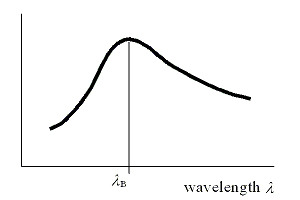
The measure of the light intensity diffracted from a grating is called its efficiency. The blaze wavelength is defined as that wavelength, in a given diffraction order m, for which the efficiency curve reaches its maximum. Figure 1 shows a typical efficiency curve (diffracted intensity vs. wavelength) with the blaze wavelength noted as λB.
The Blaze Wavelength in the Littrow Configuration
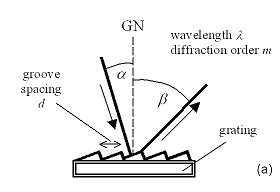
The effect of the groove pattern of a grating on the direction of light diffracted by it is governed by the grating equation,
mλ = d(sinα + sinβ) (1)
where α is the angle of incidence, β the angle of diffraction, λ and m the wavelength and diffraction order, and d the spacing between adjacent grooves on the grating surface.
The Littrow configuration is that specific geometry in which the light of a specific wavelength diffracted from a grating, into a given diffraction order, travels back along the direction of the incident light: in Eq. (1) above, this requires
α = β (the Littrow configuration). (2)
For the Littrow configuration, the grating equation simplifies to
mλ = 2dsinα (3)
Both the general configuration, as given in Eq. (1), and the Littrow configuration are shown in Figure 2.
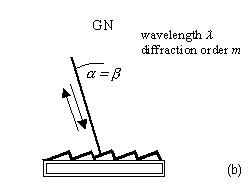
The blaze wavelength in the Littrow condition is that for which the efficiency curve, such as that shown in Figure 1, reaches its maximum when the grating is maintained in the Littrow configuration while the wavelengths are scanned. This requires the grating to rotate to scan wavelength, usually called the monochromator configuration.
The Richardson Gratings Diffraction Grating Product Guide indicates the Littrow blaze wavelength (for the first diffraction order, m = 1) for each of its gratings. For ruled gratings (whose grooves are triangular), the blaze wavelength for other orders can be found by the approximation
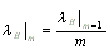
namely, the blaze wavelength in order m (Littrow configuration) is approximately equal to the blaze wavelength in the first order, divided by m. For holographic gratings (whose grooves are sinusoidal), Eq. (4) is not valid [see Loewen et al.]
The Littrow blaze angle θB is defined as the diffraction angle (in the Littrow condition) for the blaze wavelength:
mλB = 2dsinθB (5)
The Blaze Wavelength for Other Configurations
mλB = 2dsinθBcos(α - θB) (6)
That is, the blaze wavelength decreases with the cosine of the angle between the incidence angle α and the Littrow blaze angle θB. Eq. (6) may be very accurate or an approximation at best, depending on the groove profile and illumination conditions.
Efficiency at the The Blaze Wavelength
While it is relatively straightforward, as shown above, to determine the wavelength λB of maximum efficiency, it is more difficult to determine the maximum efficiency itself. Since this calculation requires the use of Maxwell's equations, it is generally addressed by computer simulation. There are a handful of computer-based grating efficiency programs, some of which are available commercially; Richardson Gratings uses PC Grate to simulate the efficiency behavior of its gratings.