Diffraction Grating Efficiency and Groove Shape
The maximum efficiency of a grating is typically obtained with a simple smooth triangular groove profile, as shown in Figure 9-4, when the groove (or blaze) angle θB is such that the specular reflection angle for the angle of incidence is equal (in magnitude and opposite in sign) to the angle of diffraction. Ideally, the groove facet should be flat with smooth straight edges and be generally free from irregularities on a scale comparable to a small fraction (< 1/10) of the wavelength of light being diffracted.
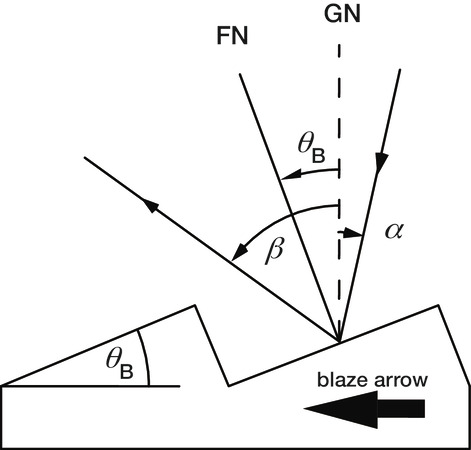
Fraunhofer was well aware that the distribution of power among the various diffraction orders depended on the shape of the individual grating grooves. Wood, many decades later, was the first to achieve a degree of control over the groove shape, thereby concentrating spectral energy into one angular region. Wood's gratings were seen to light up, or blaze, when viewed at the correct angle.