Information on Spectral Irradiance Data
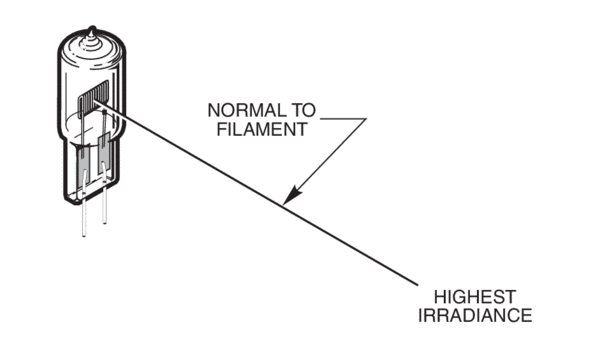
The lamps are operated vertically and the measurement is made in the horizontal plane through the center of the radiating filament or arc. The lamps are rotated for maximum flux at the measurement site. This is particularly important for our planar filament quartz tungsten halogen lamps. At 0.5 m the flux density of all our lamps is uniform over at least a 25 x 25 mm2 area. As you move out of the plane but still maintain the same 0.5 m distance and face the source, the recorded power should in principle fall according to Lambert’s Law for a planar source and remain constant for a point source. Measurements show something in between, with the arc lamps resembling point sources up to the electrode shadowing limit.

As you change the measuring distance from 0.5 m, the irradiance follows the inverse square law providing the distance, d, is larger than 20 to 30 times the radiating element size. The shortest distance we use in our measurements is 300 mm.

Working with Semi-Log Displays
The advantage of the semi-log display is the range our graphs cover, from very low levels to large peaks. Fig. 4 shows the linear display of the graph shownin Fig. 3. You get a much better sense of the height of the peaks, but the values at lower levels are lost.
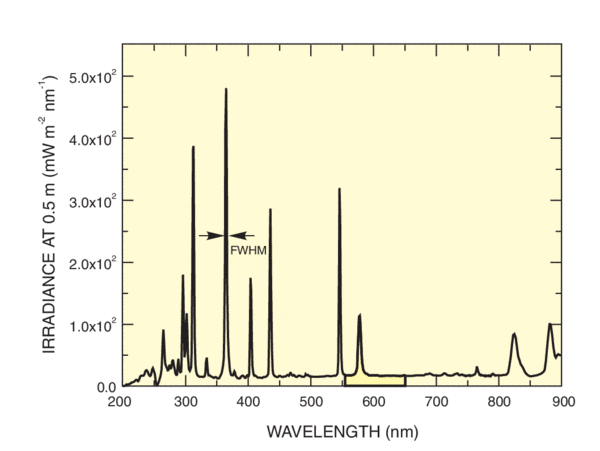
The logarithmic compression can be deceptive when it comes to estimating the area under a portion of the curve, to determine the total irradiance from λ1 to λ2, for example. You cannot rely on a rapid visual comparison unless you remember that the area at the bottom must be discounted appropriately. The peaks are much more important than they seem! So, you should calculate the area using the data values you read from the curve.
The logarithmic scale complicates estimation of the amount of irradiance in any peak. The half maximum is no longer halfway between the peak top and the bottom of the graph. You can easily find the half maximum by measuring the distance from 1 to 2, or 10 to 20, etc., on the logarithmic axis scale. Moving down this distance from the peak locates the half maximum (Fig. 5). We discuss the spectral peaks in the discussion on see Calculating Output Power

How Good is the Data?
We measured the irradiance data on all our lamps using both multichannel detectors with our MS257™ Spectrograph, and scanning monochromators. We used integrating spheres for most of the measurements. This effectively averages the polarization of the incoming radiation. Stress birefringence in the arc lamps and the filament structure of the lower power QTH lamps cause noticeable polarization of the output that may enhance or detract from your application.
We have a high degree of confidence in our data and cross check them with full radiant power meters and calibrated filters. The measurements are of lamps early in their life, operated in open air. Thermal conditions are different for lamps operated in lamp housings, and the spectral distribution changes slightly as the lamps age. Mercury lamps are particularly sensitive to thermal changes.
We see ±15% variation in output from lamp to lamp even within the same batch of lamps. We see substantially more variation in the UV output (
In short, we believe that this set of data is the most comprehensive and reliable you will find for lamps of this type and are an excellent resource for first estimates. But don't base a tightly toleranced system design on the data without additional characterization of the lamp in its intended operating environment.
Finding the Right Spectral Irradiance Curve
Refer to Table 1 to find the model of a lamp you are interested in. You can then click on the model for the spectral irradiance graph and additional information and specifications.
Table 1 UV-IR Radiation Sources
| Model | Lamp Type | Wavelength Range | Type/Wattage |
|---|---|---|---|
| 63162 | Deuterium | ~160 to 400 nm | 30 Watt Deuterium Lamp, 1 mm Arc |
| 63163 | Deuterium | ~160 to 400 nm | 30 Watt Deuterium Lamp, 0.5 mm Arc |
| 63165 | Deuterium | ~160 to 400 nm | 30 Watt Deuterium Lamp, 0.5 mm Arc, Ozone Free |
| 6251NS | Xenon | 200 to 2500 nm | 75 Watt Xenon Arc lamp |
| 6247 | Xenon | 200 to 2500 nm | 75 Watt Xenon, High Stability Arc Lamp |
| 6263 | Xenon | 200 to 2500 nm | 75 Watt Xenon Arc Lamp ( Ozone Free) |
| 6257 | Xenon | 200 to 2500 nm | 100 Watt Xenon, Ozone Free Arc Lamp |
| 6255 | Xenon | 200 to 2500 nm | 150 Watt Xenon Arc lamp (Ozone Free) |
| 6254 | Xenon | 200 to 2500 nm | 150 Watt Xenon, UV Enhanced Arc lamp |
| 6256 | Xenon | 200 to 2500 nm | Xenon Arc Lamp, 150 W |
| 6258 | Xenon | 200 to 2500 nm | 300 Watt Xenon Arc lamp (Ozone Free) |
| 6267 | Xenon | 200 to 2500 nm | 500 Watt Xenon Short Arc Lamp, Ozone Free |
| 6271 | Xenon | 200 to 2500 nm | 1000 Watt Xenon Arc lamp (Ozone Free) |
| 62711 | Xenon | 200 to 2500 nm | 1600 Watt Xenon, Ozone Free Arc Lamp |
| 6427 | Pulsed Xenon | 200 to 2500 nm | 60W Flash Lamp, 5 J, 9 µs, 60Hz |
| 6282 | Mercury | 200 to 2500 nm | 50 Watt Mercury Lamp |
| 6283NS | Mercury | 200 to 2500 nm | 200 Watt Mercury Lamp |
| 6286 | Mercury | 200 to 2500 nm | 350 Watt Mercury Lamp |
| 6285 | Mercury | 200 to 2500 nm | 500 Watt Mercury Lamp |
| 6287 | Mercury | 200 to 2500 nm | 1000 Watt Mercury Lamp |
| 6291 | Mercury (Xenon) | 200 to 2500 nm | Hg(Xe) Arc Lamp, 200 W |
| 6292 | Mercury (Xenon) | 200 to 2500 nm | 200 Watt Hg(Xe) Lamp, Ozone Free |
| 66142 | Mercury (Xenon) | 200 to 2500 nm | 500 Watt Hg(Xe) Lamp |
| 6293 | Mercury (Xenon) | 200 to 2500 nm | 1000 Watt Hg(Xe) Lamp |
| 6295NS | Mercury (Xenon) | 200 to 2500 nm | 1000 Watt Hg(Xe) Lamp, Ozone Free |
| 62712 | Mercury (Xenon) | 200 to 2500 nm | 1600 Watt Hg(Xe), Ozone Free Arc Lamp |
| 6297 | EmArc™ Enhanced Metal Arc | 200 to 2500 nm | 200 Watt EmArc™ Enhanced Metal Arc |
| 6332 | Quartz Tungsten Halogen | 240 to 2700 nm | 50 Watt Quartz Tungsten Halogen, Short Filament |
| 6337 | Quartz Tungsten Halogen | 240 to 2700 nm | 50 W Quartz Tungsten Halogen Lamp |
| 6333 | Quartz Tungsten Halogen | 240 to 2700 nm | 100 Watt Quartz Tungsten Halogen |
| 6334NS | Quartz Tungsten Halogen | 240 to 2700 nm | 250 Watt Quartz Tungsten Halogen Lamp |
| 6336 | Quartz Tungsten Halogen | 240 to 2700 nm | 600 Watt Quartz Tungsten Halogen Lamp |
| 6315 | Quartz Tungsten Halogen | 240 to 2700 nm | 1000 W Quartz Tungsten Halogen |
| 6317 | Quartz Tungsten Halogen | 240 to 2700 nm | 1000 W, 28000 Lumens, 3200 K Color Temp. |
| 6363 | Infrared Elements | 1 to 25 µm | IR Emitter, 140 W Element |
| 6575 | Infrared Elements | 1 to 25 µm | Infrared Ceramic Element, 22 Watt |
| 6580 | Infrared Elements | 1 to 25 µm | Low Cost Infrared Element, 9 Watt |
| 80030 | Infrared Elements | 1 to 25 µm | 24 W SiC Source Element |
Spectral Irradiance Data
Spectral irradiance curves for our lamps and solar simulators can be found below.