Thermal Performance of Optical Mirror Mounts
Design Issues to Minimize Thermal Drift
In order to minimize drift due to thermal effects, it is important to consider not just the materials used but also the design of the mount and the joints.
Materials: Thermal expansion causes a change in the size and shape of parts. A material’s thermal property is characterized by the coefficient of thermal expansion, a, where the change in size, ΔL, is related to a temperature change, ΔT, by ΔL=aLΔT (L is the length of the component in that direction). Therefore, the amount of change depends upon the size, material and temperature variation. The most common materials used to make optomechanical components are aluminum, brass, and stainless steel. Because ceramic has superior properties as compared to metal (stiffer, lower coefficient of thermal expansion, and lower thermal and electrical conduction), we now also offer ceramic pedestals. As listed in Table 1, aluminum is twice as sensitive to temperature changes as stainless and brass. This is why applications requiring interferometric stability often use stainless steel. However, it is important to note that aluminum has a significantly higher thermal conductivity and is therefore good for applications that require dissipating heat quickly, such as to avoid thermal gradients that cause significant distortion
Mirror-Mount Configurations
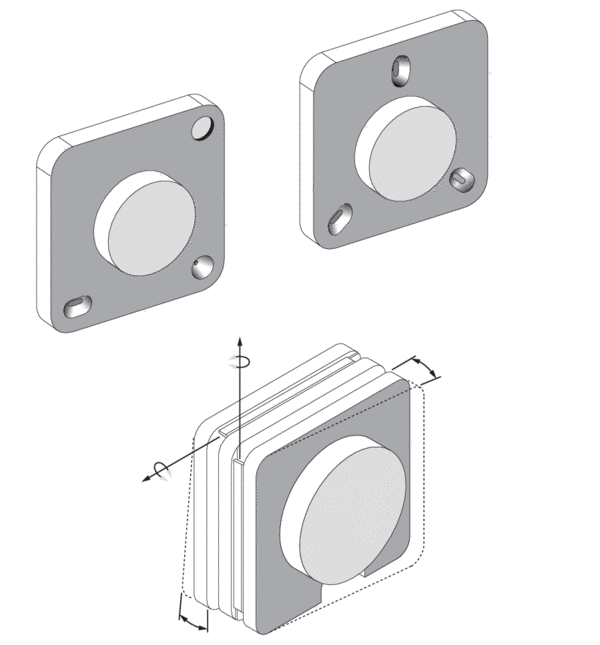
In order to minimize irreversible shifts leading to unwanted drift, the design of the mount is important. For instance, the bladed flexure mount has the worst thermal stability because the flexures, the most critical element in the mount, have relatively small thermal mass and are subject to changes in environmental temperature. As the flexures heat and cool, they do so non-uniformly, causing distortion. The best mounts are those employing true kinematic design principles (the condition where there exists exactly one constraint or actuator for each of the six independent degrees of freedom). There are two types of kinematic mounts—the “vee, cone and flat” mount and the “three-vee” mount. (See Figure 1) In all cases, you also need to consider the length of each actuator or adjustment screw. If they differ in length (such as in a top-actuated mount) then you’ll get some distortion because each will expand different amounts. (Standard mirror mounts will always be more stable than top mounts, because the extra mechanism to turn the screw action through 90° will yield kinematic ambiguity and hence instability.)
Table 1: Thermal Performance Properties by Material
| Material | Aluminum | Stainless Steel | Brass |
|---|---|---|---|
| Stiffness, k (MPSI) | 10.5 | 28 | 14 |
| Coefficient of Thermal Expansion, α (µin in-1 F-1) | 12.4 | 5.6 | 11.4 |
| Coefficient of Thermal Conduction, c (BTU hr-1 ft-1 F-1) | 104 | 15.6 | 67 |
Joints: In addition to understanding the effect temperature variations have on materials and specific design configurations, it also important to understand how joints perform when the temperature changes. Temperature variations cause irreversible shifts in position from the fluid flow of grease and the unrelieved stress in kinematic seats. The ideal joint thus should minimize grease and have low friction, thus little stress. In a low-friction joint, each ball is uniquely located in its cone, vee, or flat seat. The restoring force of the spring pulls the mount plate as far as possible into the seats where it is kinematically seated in its unique resting point. If, however, there exists high friction, such as when there’s some roughness in the seats, the balls will not have a single and final resting point. If there’s some slippage due to temperature, creep, shock, or vibration, the component will move. In this case, the component is no longer truly kinematic and will suffer from long-term instabilities. Thus, a good joint will have sapphire seats or hardened steel pads to reduce friction.