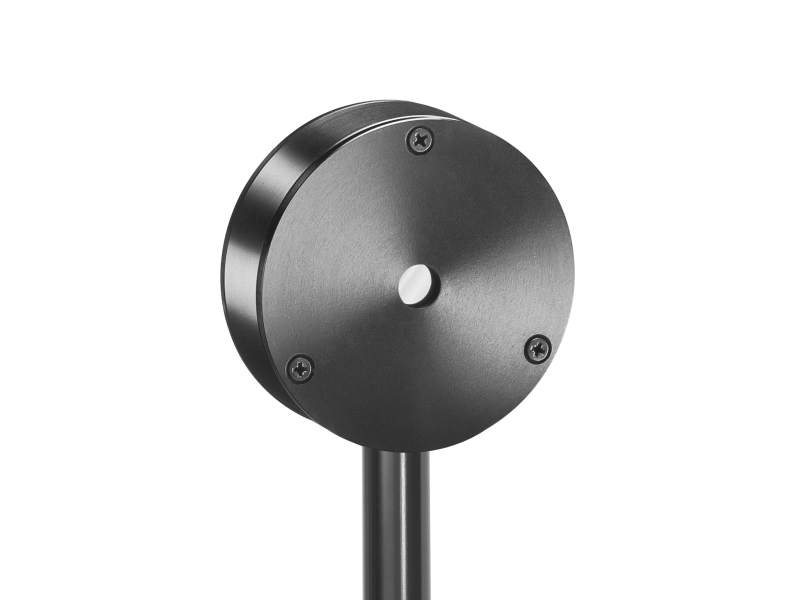
The 919E-200U-8-25K pyroelectric energy detector is for very low energies and has an 8 mm diameter aperture. It can measure energies from <0.05 uJ to 200 uJ. It can operate at repetition rates up to 25 kHz and covers the spectral range from 0.15 - 12 µm. The sensor comes with a standard 1.5 meter cable for connecting to a power meter. Compatible with power meter models 1919-R, 843-R, 843-R-USB, and 841-PE-USB. Certain specifications are interrelated with various settings, please refer to the complete specifications sheet under Resources below to determine if this product meets your requirement. It has one 1/4-20 tapped hole for mounting and comes with a 1/2 inch diameter post.
Pyroelectric Sensor Pulse Energy Measurement

The configuration of a typical pyroelectric sensor and its operational output can be seen in the above Figure. A pyroelectric material, which is usually crystalline, possesses an electric polarization, even in the absence of an applied voltage. An incident laser pulse heats the crystal, which causes the material to expand and produce a change in the polarization. Charge builds up on opposite surfaces of the crystal which generates a current flow that charges a capacitor. This charged capacitor induces a voltage whose amplitude change is proportional to the original laser pulse energy. Since it is the change in temperature that produces the current, pyroelectric detectors respond only to pulsed or modulated radiation. They respond much more rapidly to variations in radiation than thermopiles and are unaffected by steady background radiation.