Modal Analysis Service
A Powerful Analytical Tool
Our modal analysis service gives you a valuable tool to assist you in evaluating and meeting the vibration control requirements of your application.
Modal Analysis
- Experimentally measures actual displacement amplitudes over entire work surface
- Identifies low-displacement "sweet spots" for highest performance of critical equipment
- Simulation of your unique equipment setups allow investigation of different placement options for best performance
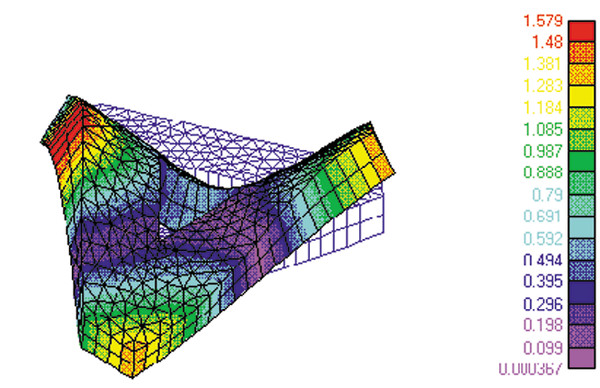
Modal analysis takes the concept of relative motion one step further by providing a three-dimensional graphic representation of table top displacements of the entire work surface. In addition to providing direct, experimental proof of vibration isolation and structural performance, modal analysis identifies the locations of the "sweet spots" on the structure. Pinpointing these locations, where the motion amplitude of the work surface is lowest, indicates the best locations to place critical equipment for the absolute highest stability and performance attainable.


About Modal Analysis Testing
Modal analysis characterizes the deformation of a structure due to external vibration input. When the structure is excited by external vibrational energy, it is deformed in a number of well-defined wave-like patterns or modes. Each mode has its own specific natural frequency and mode shape and damping factor.
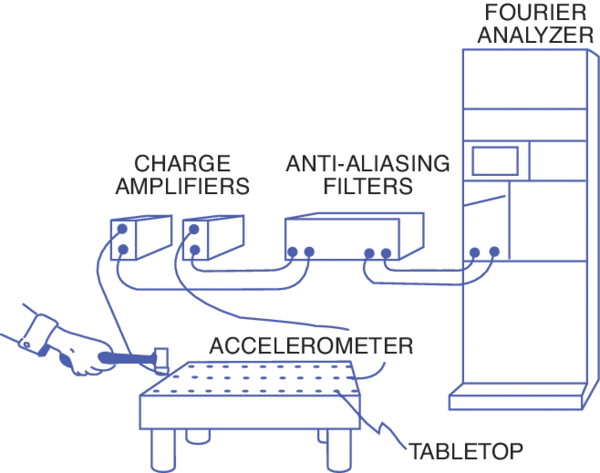
Modal properties are determined by exciting the structure with random vibration and measuring the response at an array of test points with a Fast Fourier Transform analyzer.
Sophisticated software then processes the experimental data into the three-dimensional map calibrated in English or metric displacement units. The resolution of this technique is quite high on the order of 10(10) in. or better of relative motion.