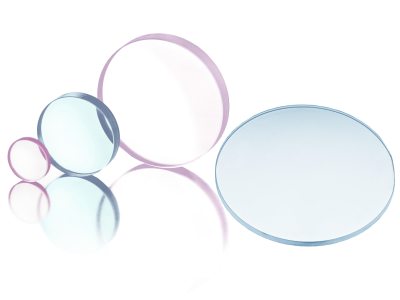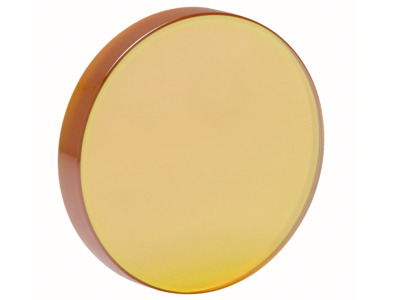
ZnSe Meniscus CO2 Laser Lenses
ZnSe Meniscus CO2 Laser Lenses
Our CO2 laser meniscus lenses offer superior performance and longer lifetime. Meniscus lenses enable a smaller beam diameter and hence, a reduction in spherical aberration and less beam waste when precision cutting or marking with a CO2 laser.
- Meniscus lens for smaller spot size
- High IR transmission Zinc Selenide (ZnSe) substrates
- Approved and used by leading OEMs See All Features
| Compare | Description | Drawings, CAD & Specs | Avail. | Price | ||
|---|---|---|---|---|---|---|
 | 60616-117 | |||||
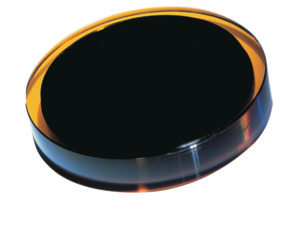 | 60616LA | |||||
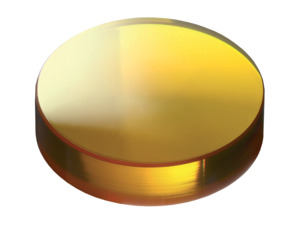 | 60616ULA | |||||
| 60698-117 | |||||
| 61982-117 | |||||
| 61982LA | |||||
| 61982ULA | |||||
| 61983-117 | |||||
| 61983LA | |||||
| 61983ULA | |||||
| 631079-117 | |||||
| 631079-117LA | |||||
| 631079-117ULA |
Specifications
- Lens ShapeMeniscus
- Lens MaterialZinc Selenide (ZnSe)
- Surface Accuracy, Irregularity0.5 Fringe @ 0.633 µm
- Surface Figure2 Fringes @ 0.633 µm
- Diameter Tolerance+0.0/-0.1 mm
- Edge Thickness Tolerance±0.1 mm
- Clear Aperture≥ 90%
Features
Reduced Spherical Aberration
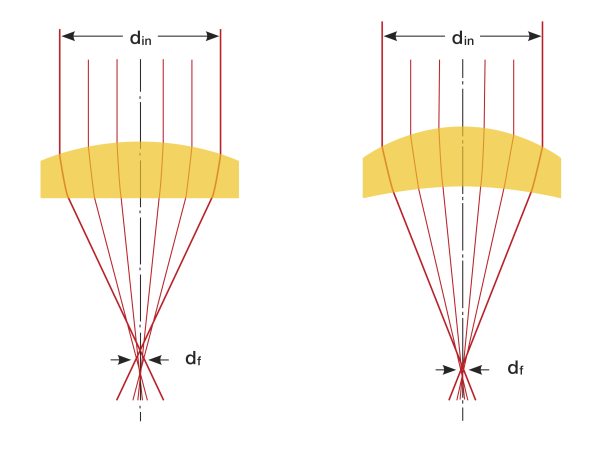
In most laser cutting machines, meniscus lenses are used because they produce a smaller focus diameter. In some machines, plano-convex lenses are used because their production costs are a little bit lower.
Spherical aberration means that the focus position of the outer portion of the laser beam is closer to the lens than the focus position of the inner portion (see picture below). As a consequence, the focus diameter is not zero, but has some blur circle that can be approximated by the following formulas:
df = 0.0286 (din)3 / (FL)2 (plano-convex lenses)
df = 0.0187 (din)3 / (FL)2 (meniscus lenses)
df = focus diameter, din = diameter of incoming beam in millimeters, FL = focal length in inches
Example: din = 20 mm, FL = 3.75 in.
>>> df = 0.025 mm (plano-convex lens)
>>> df = 0.017 mm (meniscus lens)
Virtual Tour of Ophir Optics Manufacturing Capabilities
Join us for a virtual tour at our Jerusalem production site to learn how we provide a one-stop-shop solution, from design to manufacture, assembly and QA, for optical components and assemblies to IR thermal imaging and high-power laser applications.
Low Absorption Coating Advantages
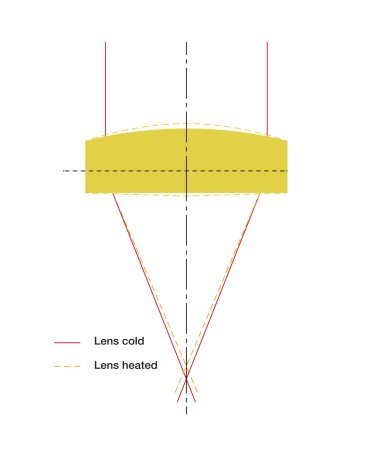
During laser operation with several kilowatts, the focusing lens is heated because it absorbs a small portion of the laser power. A standard AR coating is absorbing typically less than 0.2% of the incoming laser power. A lens with Ophir Black Magic™ coating has a maximum absorption value of 0.15%. A lens with Ophir Clear Magic™ coating has a guaranteed absorption value less than 0.13%.
During use in a laser cutting machine, absorption increases gradually due to increasing amount of dirt on the lower surface of the lens as well as changes in the molecular structure of the crystal. When the lens needs to be replaced, the absorption value usually exceeds 0.4%.
Heating of the lens causes additional surface curvature due to thermal expansion and increases the refractive index of the lens material. These effects are referred to as thermal lensing. As a consequence of these effects, the lens focal length becomes shorter, and the focus position cannot be predicted exactly because it depends on many parameters like laser power, intervals laser on/off, cleanliness of lens, and others. Therefore, use of lenses with reduced absorption can reduce thermal lensing, make the focal length more stable and therefore improve reliability of the cutting process.
Mounting Distance vs. Focal Length
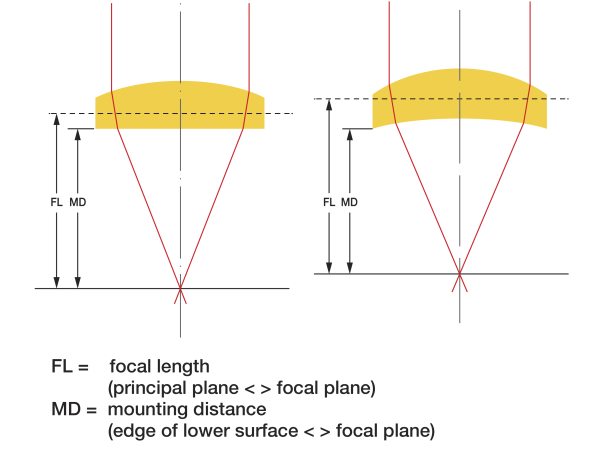
For a laser user who thinks about replacing a plano-convex lens with a meniscus lens, it is important to check if the focus position can be adjusted correctly. The focus position is the distance between the focus and the so-called principal plane – also known as the 'Focal Length', the principal plane is defined according to a scientific rule and is located at the optical center of the lens.
Therefore, even if a plano-convex lens and a meniscus lens have same diameter, thickness and focal length, the focus position of the meniscus lens can be several mm higher if compared to the plano-convex lens. For checking the position of the focus in a laser cutting head, it is much more useful to know the "Mounting Distance" of the lens.
Resources
Literature
Ophir Laser Optics Catalog(21.3 MB, PDF) Duralens™ CO2 Laser Lenses(650.4 kB, PDF)
Technical Notes
CO2 Laser Optics Cleaning(2.1 MB, PDF)