230-266 nm Antireflection Coated High Energy Plano-Convex Lenses
230-266 nm Antireflection Coated High Energy Plano-Convex Lenses
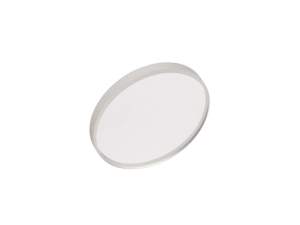
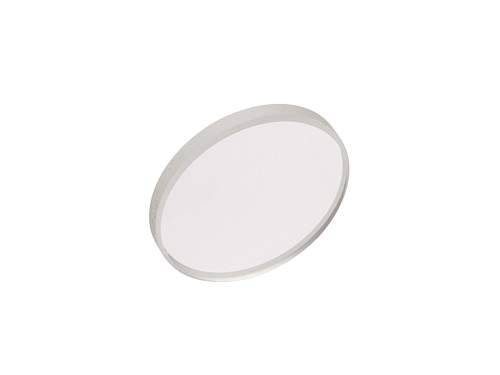
These 230-266 nm broadband UV antireflection coated high purity fused silica plano-convex lenses are designed for high energy laser pulses where standard grade fused silica does not perform very well.
- 230-266 nm antireflection coating
- High performance HPFS 7978 fused silica substrates
- ≤λ/8 surface irregularity, 15-5 scratch-dig See All Features
| Compare | Description | Drawings, CAD & Specs | Avail. | Price | ||
|---|---|---|---|---|---|---|
 | SPX014AR.4Plano-Convex Lens, Fused Silica, 25.4 mm, 33.0 mm EFL, AR.4 coated | |||||
| SPX022AR.4Plano-Convex Lens, Fused Silica, 25.4 mm, 100 mm EFL, AR.4 coated | |||||
| SPX023AR.4Plano-Convex Lens, Fused Silica, 25.4 mm, 125 mm EFL, AR.4 coated | |||||
| SPX025AR.4Plano-Convex Lens, Fused Silica, 25.4 mm, 150 mm EFL, AR.4 coated | |||||
| SPX028AR.4Plano-Convex Lens, Fused Silica, 25.4 mm, 200 mm EFL, AR.4 coated | |||||
| SPX029AR.4Plano-Convex Lens, Fused Silica, 25.4 mm, 250 mm EFL, AR.4 coated | |||||
| SPX030AR.4Plano-Convex Lens, Fused Silica, 25.4 mm, 350 mm EFL, AR.4 coated | |||||
| SPX031AR.4Plano-Convex Lens, Fused Silica, 25.4 mm, 500 mm EFL, AR.4 coated | |||||
| SPX034AR.4Plano-Convex Lens, Fused Silica, 25.4 mm, 1000 mm EFL, AR.4 coated | |||||
| SPX059AR.4Plano-Convex Lens, Fused Silica, 25.4 mm, 300 mm EFL, AR.4 coated | |||||
| SPX060AR.4Plano-Convex Lens, Fused Silica, 25.4 mm, 400 mm EFL, AR.4 coated | |||||
| SPX061AR.4Plano-Convex Lens, Fused Silica, 25.4 mm, 50 mm EFL, AR.4 coated | |||||
| SPX062AR.4Plano-Convex Lens, Fused Silica, 25.4 mm, 75 mm EFL, AR.4 coated |
Specifications
- Lens ShapePlano-Convex
- Diameter25.4 mm
- Lens MaterialHPFS 7978
- Antireflection Coating230 to 266 nm
- Coating TypeUV Multilayer
- Coating CodeAR.4
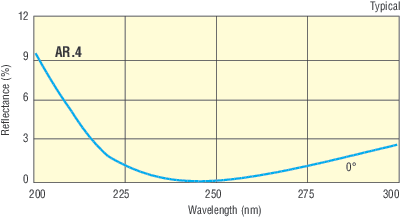
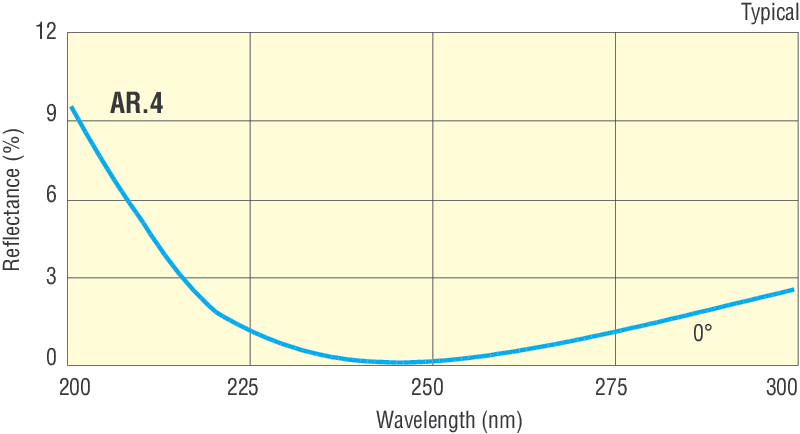
- ReflectanceRavg<0.50% @ 230-266 nm
- Surface Quality15-5 scratch-dig
- Surface Flatnessλ/10
- Chamfers0–0.8 mm face width
- Chamfers Angle/Tolerance45° ±15°, typical
- Focal Length Tolerance±1%
- Diameter Tolerance+0/-0.1 mm
- Center Thickness Tolerance±0.1 mm
- Clear Aperture22.86 mm
Features
High Purity Fused Silica Substrates
These lenses feature Corning HPFS 7978 high purity fused silica substrates. HPFS 7978 has very low hydroxyl molecule presence compared to standard fused silica material, which results in less absorption of laser light and greatly reduce the chances of internal damage of the lenses, making them ideal for high energy applications. For more information, refer to the optical material tech note.

High Quality Precision Lens Surfaces
Our precision plano-convex lenses are polished to tight tolerances minimizing wavefront distortion. Tight surface quality tolerances minimize scatter and unwanted diffraction effects. These lenses have a 15-5 scratch-dig surface quality, and a λ/10 surface irregularity. For more information, refer to the optical surfaces technical note.
Broadband UV Antireflection Coating
The AR.4 UV multilayer antireflection coating markedly improves the transmission efficiency of these lenses by reducing surface reflections over a 230 to 266 nm wavelength range.
Standardized Plano-Convex Focal Lengths
Standard effective focal lengths across a variety of newport lens sizes, materials and shapes provide a systematic approach allowing for lenses of different sizes to be interchanged without requiring other changes to your optical system. Collimating a point light source coming from the planar surface or focusing a collimated light source which is incident on the curved surface will help to minimize the spherical aberration.

Plano-Convex Lens Shape for Focusing Light
Plano-Convex lenses are the best choice for focusing parallel rays of light to a single point. They can be used to focus, collect and collimate light. The asymmetry of this lens shape minimizes spherical aberration in situations where the object and image are located at unequal distance from the lens. The optimum case is where the object is placed at infinity with parallel rays entering lens and the final image is a focused point.

Focusing a Collimated Laser Beam
For an application example, let’s look at the case of the output from a Newport R-31005 HeNe laser focused to a spot using a KPX043 Plano-Convex Lens. This Hene laser has a beam diameter of 0.63 mm and a divergence of 1.3 mrad. Note that these are beam diameter and full divergence, so in the notation of our figure, y1 = 0.315 mm and θ1 = 0.65 mrad. The KPX043 lens has a focal length of 25.4 mm. Thus, at the focused spot, we have a radius θ1f = 16.5 µm. So, the diameter of the spot will be 33 µm.

Collimating Light from a Point Source
Since a common application is the collimation of the output from an Optical Fiber, let’s use that for our numerical example. The Newport F-MBB fiber has a core diameter of 200 µm and a numerical aperture (NA) of 0.37. The radius y1 of our source is then 100 µm. NA is defined in terms of the half-angle accepted by the fiber, so θ1 = 0.37. If we again use the KPX043 , 25.4 mm focal length lens to collimate the output, we will have a beam with a radius of 9.4 mm and a half-angle divergence of 4 mrad.

Mounted Version - with Lens Tubes
The lenses can be mounted in LT series lens tube for constructing a complex optical system or quickly connecting to other threaded lens mounts: A-Line™ series fixed lens mount, or adjustable lens positioner (with thread adapter). Use LT-WR series spanner wrench for easy lens installation.