Diffraction Gratings for Oriel® CS260 Monochromators and MS260i Imaging Spectrographs
Diffraction Gratings for Oriel® CS260 Monochromators and MS260i Imaging Spectrographs
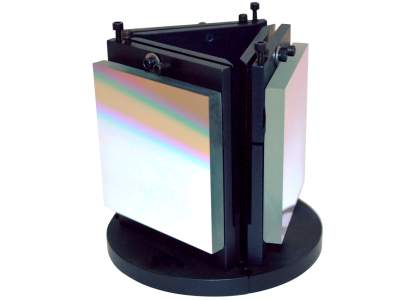
High quality diffraction gratings are available for use with the Oriel® CS260 family of monochromators and MS260i imaging spectrographs. These instruments are designed to hold up to three gratings simultaneously. This selection covers a broad wavelength range and gratings can be replaced, making the CS260 and MS260i flexible instruments that meet the needs of many different applications. Gratings are installed by Newport. Contact us for more information.
- High quality
- Broad wavelength coverage
- Efficient performance
- Ruled and holographic gratings
- Special orders welcome See All Features
| Compare | Description | Drawings, CAD & Specs | Avail. | Price | ||
|---|---|---|---|---|---|---|
 | 74060 | |||||
 | 74061 | |||||
| 74062 | |||||
| 74063 | |||||
| 74064 | |||||
| 74065 | |||||
| 74066 | |||||
| 74067 | |||||
| 74068 | |||||
| 74069 | |||||
| 74070 | |||||
| 74071 | |||||
| 74072 | |||||
| 74073 | |||||
| 74074 | |||||
| 74075 | |||||
| 74076 | |||||
| 74077 | |||||
| 74078 | |||||
| 74080 | |||||
| 74081 | |||||
| 74082 | |||||
 | 74160 | |||||
 | 74161 | |||||
| 74162 | |||||
| 74163 | |||||
| 74164 | |||||
| 74165 | |||||
| 74166 | |||||
| 74167 | |||||
| 74169 | |||||
| 74170 | |||||
| 74171 | |||||
| 74173 | |||||
| 74174 | |||||
| 74175 | |||||
| 74177 | |||||
| 74179 | |||||
| 74180 | |||||
| 74181 | |||||
| 74182 | |||||
| 77985 | |||||
| 77989 |
Features
High Quality

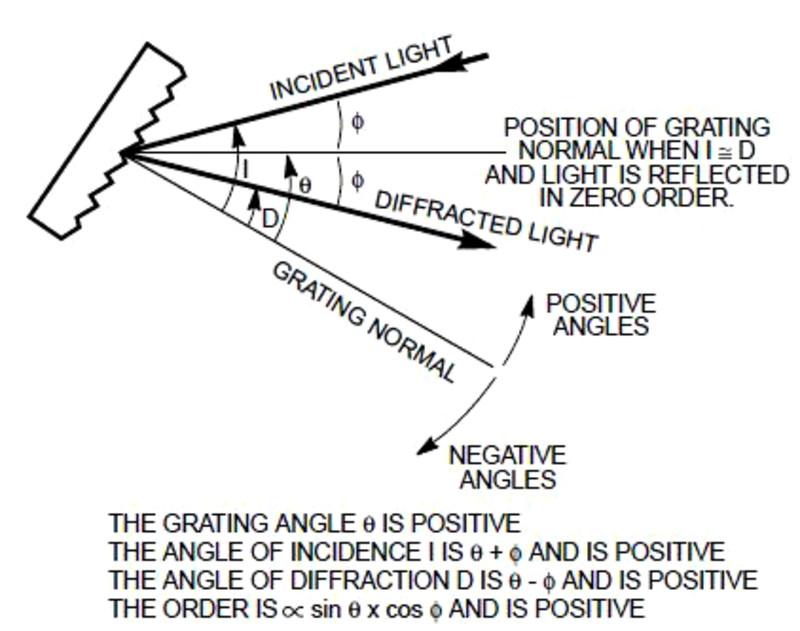
Plane ruled and holographic gratings listed here are fabricated from float glass substrates with an aluminum coating. Oriel monochromators and spectrographs feature diffraction gratings produced by Richardson Gratings. Both Oriel Instruments and Richardson Gratings are part of the Newport family of brands, and have a long history of working together to design instruments that are appropriate for a wide variety of applications.
Plane Ruled Gratings
Broad Wavelength Coverage
Standard grating assemblies are available from UV, VIS and NIR. The primary wavelength region is where the grating efficiency is greater than or equal to 20%. System efficiency will also be affected by the reflectivity of the mirrors and the grating angle, at any wavelength. The CS260 and MS260i gratings are available with operating ranges from 200 nm to 20 µm. For the broadest wavelength coverage, select grating assemblies with triple mounts. Three gratings extend the usable wavelength range of the instrument. For those applications requiring reduced stray light and/or increased throughput, select grating assemblies with double mounts. If all of these factors are important, consider using the Oriel MS257 monochromator or imaging spectrograph which holds up to four gratings and has very low stray light.