Diffraction Gratings for Oriel® CS260B Monochromators
Diffraction Gratings for Oriel® CS260B Monochromators
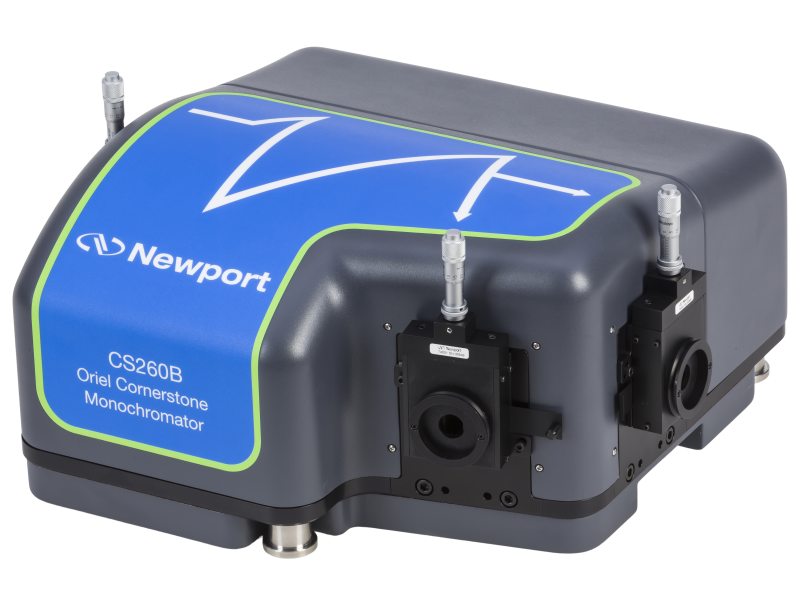
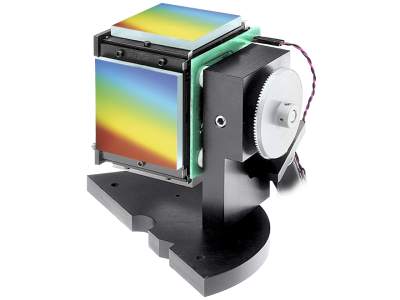
High quality diffraction gratings are available for use with the Oriel® CS260B monochromators. These instruments are designed to hold up to four gratings simultaneously. This selection covers a broad wavelength range and gratings can be customized on new instrument selections, in addition to our pre-configured models. These gratings can also be retrofitted into existing monochromator units during routine calibrations, making the CS260B a flexible instrument that meets the needs of many different applications over its extended lifetime. Gratings are installed by Newport, contact us for more information.
- Designed for use with CS260B monochromators
- Broad wavelength coverage
- Efficient diffraction performance
- Ruled and holographic gratings
- Special orders welcome See All Features


Features
Selecting a Diffraction Grating
Diffraction gratings are primarily selected based on the spectral resolution requirements of the application and the spectral region of interest.
Spectral Resolution
Diffraction gratings are available in various groove densities (i.e. lines/mm). Higher groove densities give higher reciprocal dispersion and therefore higher resolution. The grating dispersion is similar for gratings with the same groove density. The exact dispersion is dependent upon other physical characteristics of the grating in addition to the groove density.
The resolution is the ability to separate wavelengths. It is usually expressed as the Full Width Half Maximum (FWHM). The resolution can be theoretically determined by multiplying the reciprocal dispersion of the grating by the slit width. The monochromator bandpass with a 1200 lines/mm grating is half that of the same arrangement with a 600 lines/mm grating. Note that this simple relationship is not accurate for slit widths below 50 µm, as the optical aberrations begin to play a role in the resolution.
Using a grating with a high groove density may increase resolution, but the spectral range narrows. The dispersion of a grating changes inversely with the groove density. If the groove density is halved, the dispersion is doubled. When performing a scan, to save time it is important to consider the resolution when determining the interval wavelength (i.e. the step size) of the scan. For example, if the resolution with a particular grating and slit is 5 nm, it is not necessary or practical to perform a scan every 1 nm.
Spectral Region of Interest
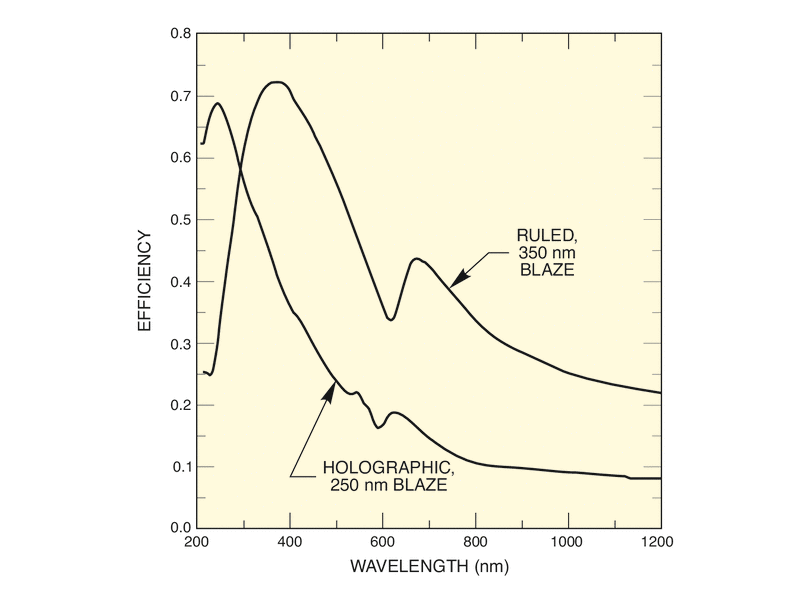
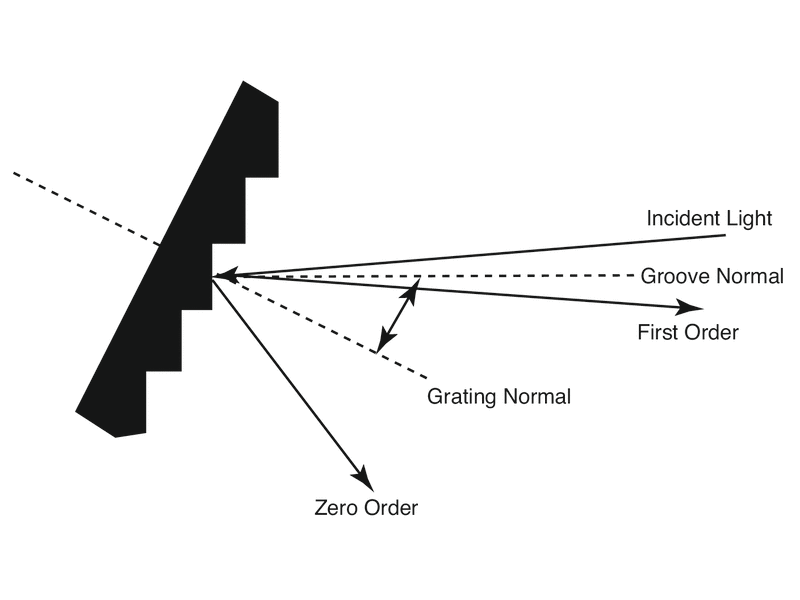
The Blaze Wavelength is the wavelength for which a blazed diffraction grating is most efficient a diffracting monochromatic light into the first order. Choosing a blaze wavelength that is close to the spectral region of interest will allow for the highest possible efficiency.
High-efficiency gratings are desirable for several reasons. A grating with high efficiency is more useful than one with lower efficiency in measuring weak transition lines in optical spectra. A grating with high efficiency may allow the reflectivity and transmissivity specifications for the other components in the spectrometer to be relaxed. Moreover, higher diffracted energy may imply lower instrumental stray light due to other diffracted orders, as the total energy flow for a given wavelength leaving the grating is conserved (being equal to the energy flow incident on it minus any scattering and absorption).
Plane Ruled Diffraction Gratings
High Quality Richardson Diffraction Gratings

Plane ruled and holographic gratings listed here are fabricated from float glass substrates with an aluminum coating. The Oriel monochromators and spectrographs feature diffraction gratings produced by Richardson Gratings. Both Oriel Instruments and Richardson Gratings are part of the Newport family of brands, and have a long history of working together to design instruments that are appropriate for a wide variety of applications.