Sorry, this family of products is no longer available.

Amplitude and Phase Characterization of Ultrashort Laser Pulses
Amplitude and Phase Characterization of Ultrashort Laser Pulses
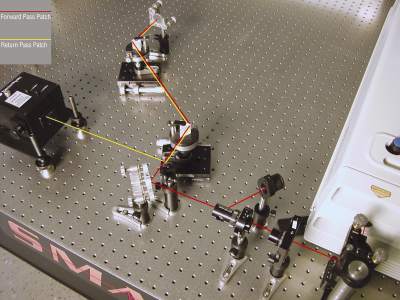
This application kit addresses a means for monitoring the spectral profile of a laser pulse as a function of time. This technique is known as frequency-resolved optical gating (FROG) which is a general technique that can be employed in a variety of experimental geometries. The focus of this kit is on two geometries: self-diffraction (SD FROG) for amplified systems and second harmonic (SHG FROG) for oscillators.
- Accurate measurement of ultrashort pulses
- Self-diffraction FROG and second harmonic FROG
- All parts selected and tested to work together See All Features
Features
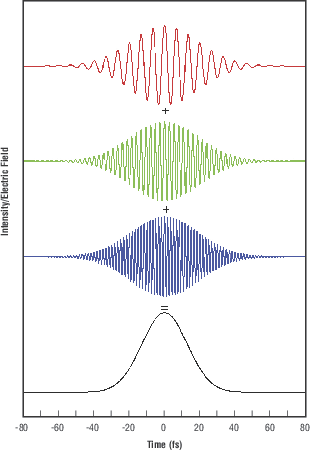
Transform Limited Ultrashort Laser Pulses
Measuring Chirped Pulses
Frequency-Resolved Optical Gating (FROG)
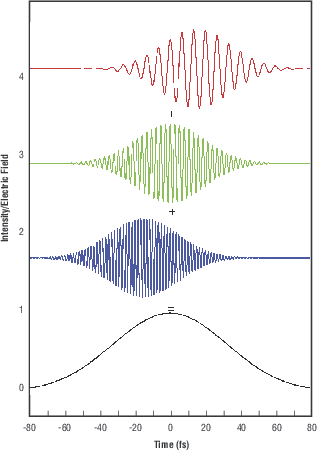
Fortunately, techniques exist that monitor the spectral profile of a pulse as a function of time. These techniques allow for the complete reconstruction of the electric field. Of these techniques, frequency-resolved optical gating (FROG) is arguably the most straightforward and easiest to implement. As mentioned earlier, FROG allows for full phase retrieval of the input field without the ambiguity associated with autocorrelation. Our Amplitude and Phase Characterization of Ultrashort Laser Pulses application note presents a simple, low dispersion, easy-to-use, general purpose FROG device that can readily be implemented on the Newport Long Scan Autocorrelator platform as described in Application Note 27.
Self-diffraction FROG Geometry
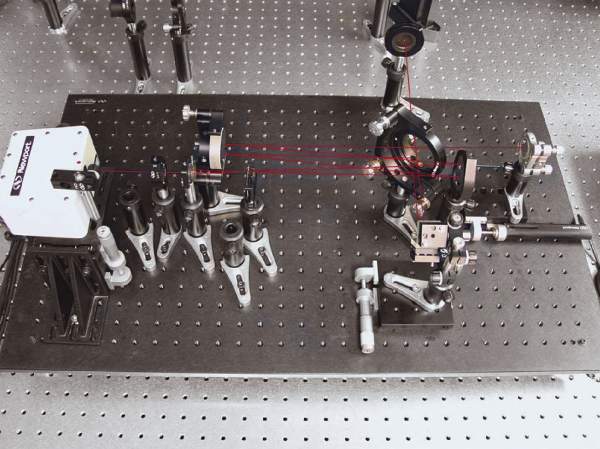
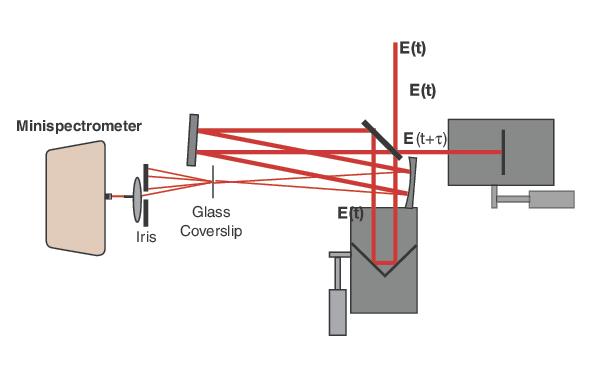
Self-diffraction FROG (SD FROG) geometries are for amplified systems. The SD FROG trace gives an intuitive picture of the pulse (i.e. the direction of time is preserved), which is a highly desirable feature for real-time laser alignment. Moreover, the geometry is identical to the Long Scan Autocorrelator where the nonlinear medium is a thin piece of glass (<200 µm), thus making this geometry cost effective and straightforward to implement. On the downside, SD FROG requires relatively high peak powers not readily available from most ultrafast oscillators, so its use is restricted to amplified systems.
Second Harmonic FROG Geometry
Second harmonic FROG (SHG FROG) geometries are the only real option for ultrafast oscillators. An SHG FROG is simply a spectrally resolved autocorrelator. Although the sign of the spectral phase is lost in the measurement, efficient algorithms exist which can deduce the order and magnitude of the spectral phase where the sign can be determined if need by performing additional measurements. (Rick Trebino, "Frequency-Resolved Optical Gating: The Measurement of Ultrafast Laser Pulses", Norwell, MA, Kluwer Academic Publishers (2000)) If planning to use the standard kit with an oscillator, a BBO crystal used to generate the second harmonic – such as Newport model

Reference Software
The data acquisition and display software included with this product has been tested in the experimental setup described in the application note and is designed to work only with specific spectrometers. Third-party freeware software is available for interpretation and analysis of complex FROG traces. Please contact us to discuss a custom version of this kit or to get additional information related to acquiring FROG analysis software.
Accessories
Resources
Application Notes
Amplitude and Phase Characterization of Ultrashort Laser Pulses(1.3 MB, PDF) Long Scan Autocorrelator(894.7 kB, PDF)