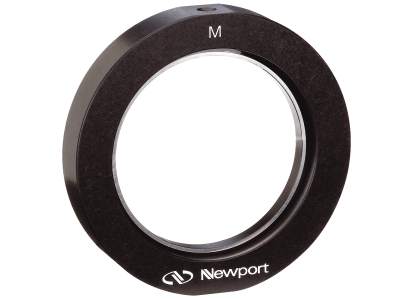
Pellicle Beamsplitter
Pellicle Beamsplitter
Pellicle beamsplitters are ultra-lightweight membranes manufactured by stretching a 5 µm thick polymer membrane over a flat metal frame. This extreme thinness eliminates multiple reflections associated with plate beamsplitters, and enables functionality at a broad wavelength range.
- Ultra-thin and extremely lightweight
- Minimal ghosting and dispersion
- Reflect curved wavefronts without spherical aberration
- Wide 375 to 2400 nm wavelength range
- Coated version for equal beamsplitting
- Uncoated version for beam sampling See All Features
Specifications
- Diameter74.9 mm
- MaterialPolymer film membrane
- Angle of Incidence45 °
- Damage Threshold2 W/cm2 CW, 1 J/cm2 with 10 nsec pulses, typical
- Surface Flatness1 fringe (1/2 wave) per inch
- Surface Quality40-20 scratch-dig
- Thickness5 µm
- Thickness Tolerance±0.06 fringes/mm
- Operating Temperature Range-40 to 70 °C
- Clear Aperture51.6 mm
- DurabilityHygroscopic film, keep from high humidity
Features
Extreme Thinness
Pellicle beamsplitters are ultra-lightweight components that virtually eliminate multiple reflections commonly associated with thicker glass beamsplitters. Pellicles are manufactured by stretching a 5 µm thick polymer membrane over a flat metal frame. The extreme thinness eliminates secondary reflections by making them coincident with the original beam. Consequently, the optic does not require AR coatings on the backside as in a traditional beamsplitting optic. Multiple wavelength versatility is an added benefit of an ultra-thin reflective membrane, making it ideal for applications where chromatic dispersion needs to be minimized.
Wide Wavelength Range
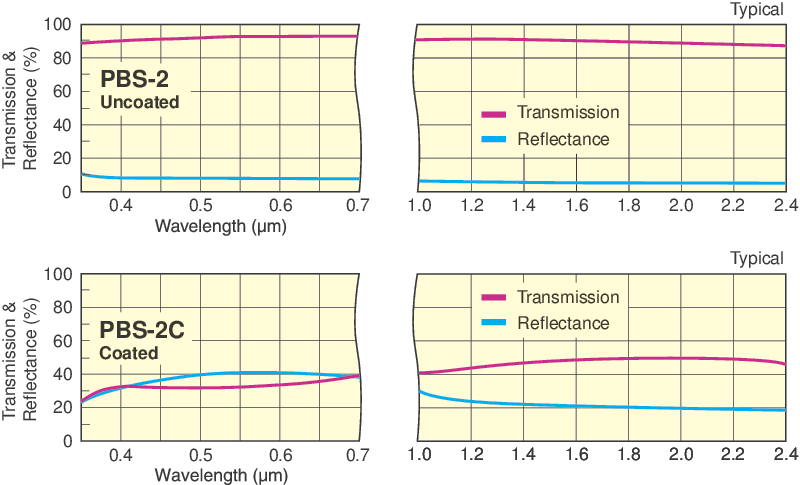
Newport's Pellicle beamsplitters are coated and uncoated to be used across an extremely wide wavelength range from 375-2400nm. The average transmittance and reflectance across a range of wavelengths and incidence angles are shown. The coated pellicle provides equal reflectance and transmission over the visible range by means of a neutral, semi-absorbing coating. The uncoated pellicle yields an average reflectivity of 8% over 375–2400 nm and is well suited for beam sampling applications requiring high transmission and low reflectance.
Interference Effects
Interference effects due to thin membranes should be considered when using pellicles, which act as low finesse interferometers. While the thin membranes are ideal for eliminating ghost images in incoherent white light applications, in monochromatic applications interference between the front and back surfaces can introduce unwanted fringes into a transmitted or reflected beam. Over any wavelength range and for a fixed incidence angle, a ±5% sinusoidal oscillation is superimposed on the spectral transmission and reflection graphs shown above. The oscillation varies rapidly with small changes in the incidence angle. When using pellicles to split beams spanning a range of angles, the oscillations will average out.