Solar Light Simulation
Basics of Solar Radiation
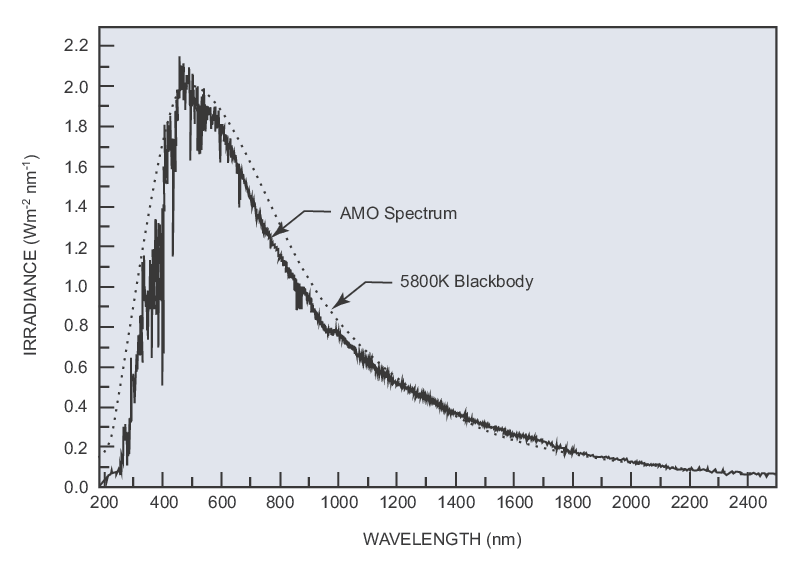
Figure 1. Spectrum of the solar radiation outside the earth's atmosphere compared to the spectrum of a 5800 K blackbody.
The electromagnetic spectrum of the solar radiation at the Earth's surface is influenced by several contributing factors, including direct and diffuse radiation. Direct radiation is energy received at the Earth's surface in a direct path from the sun, while diffuse radiation is energy received from light scattered from the sky and reflected by surroundings (Figure 2). The total radiation measured at the surface is called the Global Radiation where the direction of the target surface must be defined for global irradiance. For Direct Radiation, the target surface is orthogonal to the incoming radiation. The sun is a spherical source, about 1.39 million km in diameter. The average distance to Earth is 1 astronomical unit. The direct portion of the solar radiation is collimated with an angle of approximately 0.53 (full angle), while the "diffuse" portion is incident from the hemispheric sky and from ground reflections and scatter. The "global" irradiation, the sum of direct and diffuse components, is essentially uniform.
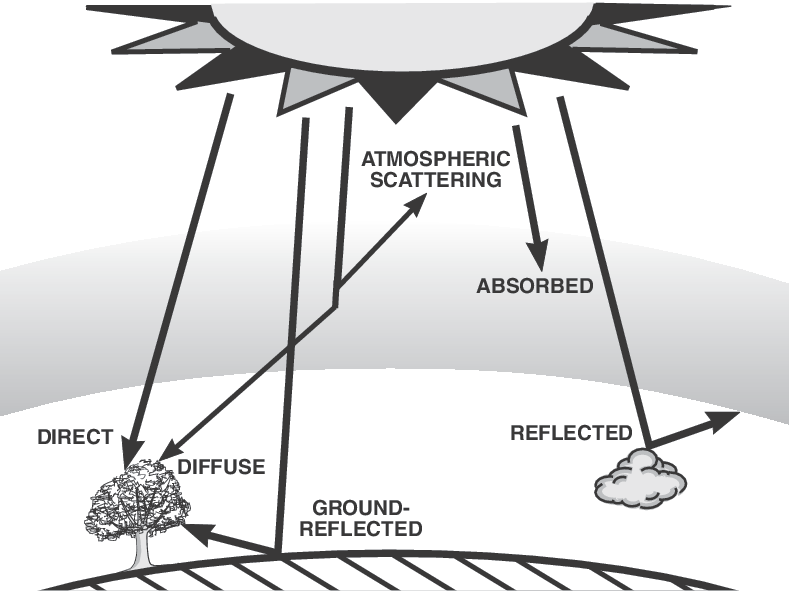
Figure 2. The total global radiation on the ground has direct, scattered, and reflected components.
The measured solar radiation incident upon the earth's surface is influenced by the amount of atmosphere through which it must pass. At any location, the length of this path to reach ground level changes as the day progresses, and there are obvious changes in ground solar radiation levels during the day as the angle of the sun changes. In addition, the shape of the spectrum can change throughout each day due to changing absorption and scattering length. Because it passes through no air mass, the extraterrestrial spectrum is called the Air Mass 0 (AM 0) spectrum. With the sun directly overhead at noon at the Earth's equator, solar radiation passes straight through the atmosphere. The solar spectrum at sea level under these conditions is called the Air Mass 1 spectrum. The global radiation with the sun directly overhead is similarly called Air Mass 1 Global (AM1G) radiation. The atmospheric path for any zenith angle is simply described relative to the overhead air mass (Figure 3). The actual path length can correspond to air masses of less than 1 (high altitude sites), to very high air masses just before sunset. MKS Solar Simulators use filters to simulate spectra corresponding to air masses of 0 and 1.5, the values on which most comparative test work is based.
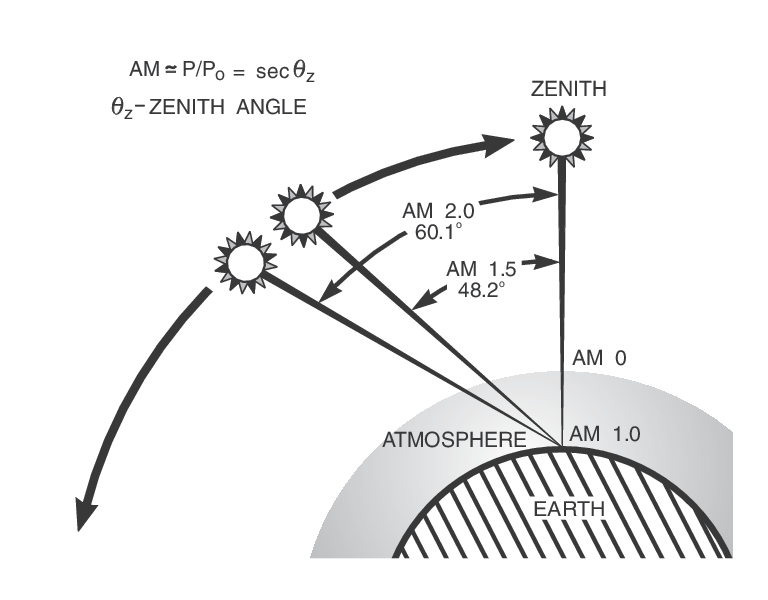
Figure 3. The path length, in units of Air Mass, changes with the zenith angle.
Xenon-based Solar Light Simulation
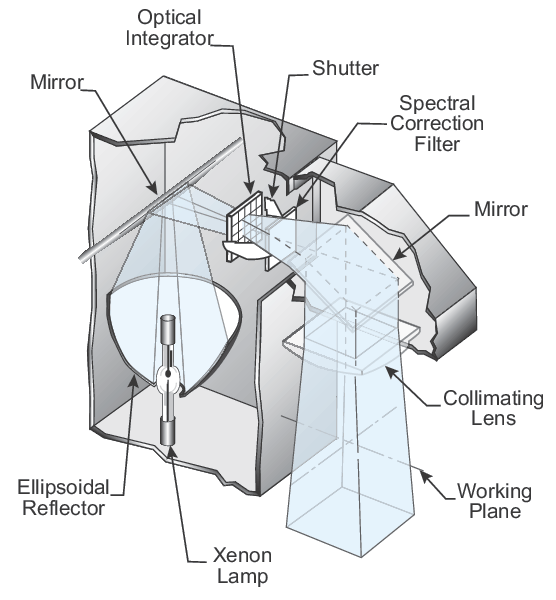
Figure 4. Light path of a solar simulator.
The Xenon lamp output differs from the solar spectrum in the 800 to 1100 nm wavelength range due to the intense atomic emission lines of Xe gas. MKS solar simulators use filters to reduce the influence of these atomic emission lines. The impact of the residual IR mismatch depends on the application. The AM Direct and AM 1.5 filters modify the VIS and UV portion of the spectrum for a better match to the standard terrestrial solar spectra.
UV Solar Simulators
UV-enhanced solar simulators are useful for work requiring an intense UV source without the complications of VIS and IR heating. This is especially important for biological work on live subjects. UV-enhanced simulators are like full spectrum solar simulators; however, their spectral distribution is modified to reduce the radiation in the VIS and IR regions of the spectrum. The UVA and UVB regions are of particular interest because natural sunlight includes UVA and UVB radiation. UV-enhanced solar simulators typically are available in three configurations:
- UVA, UVB, and UVC . this source produces UV from 210 to 400 nm
- UVA and UVB . this simulator produces UV from 280 to 400 nm and has a UVC blocking filter
- UVA . this system produces UV from 320 to 400 nm and has UVB and UVC blocking filters
For additional insights into photonics topics like this, download our free MKS Instruments Handbook: Principles & Applications in Photonics Technologies
Request a Handbook