530R Plane Ruled Diffraction Grating
530R Plane Ruled Diffraction Grating
For a plane ruled diffraction grating, the groove spacing and blaze angle determine the distribution of energy. The blaze direction for most gratings is specified for first-order Littrow use. In Littrow use, light is diffracted from the grating back toward the source. Gratings used in the Littrow configuration have the advantage of maximum efficiency, or blaze, at specific wavelengths.
- 1200 grooves per mm
- 1000 nm nominal blaze wavelength
- 36.8° nominal blaze angle
- Master 1113 default, others special upon request See All Features
| Compare | Description | Drawings, CAD & Specs | Avail. | Price | ||
|---|---|---|---|---|---|---|
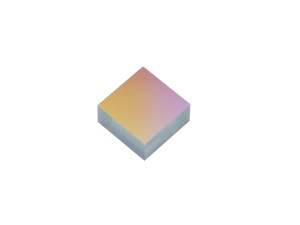 | 33025FL01-530R | |||||
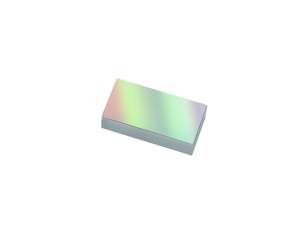 | 33066FL01-530R | |||||
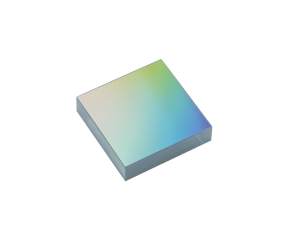 | 33009FL01-530R | |||||
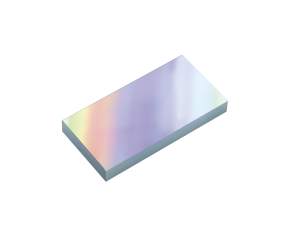 | 33067FL01-530R | |||||
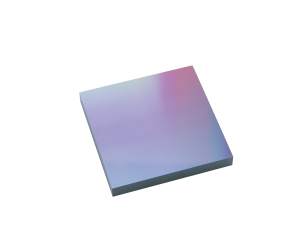 | 33010FL01-530R |
Configuration Options
If you don't find anything above that fits your application, submit a quote request to get a quote based on your requirements.
Diffraction Grating Part Number Format: AA BBB CC DD - EEE x
| Grating Type Code AA | Diffraction Grating Type | |
|---|---|---|
| 33 | Diced | |
| 53 | One-for-one | |
| Size Code BBB | Substrate Dimensions (mm) | Ruled Area (mm) |
| 108 | 16.5 x 58 x 10 | 12 x 52 |
| 004 | 30 x 30 x 10 | 26 x 26 |
| 066 | 28.5 x 58 x 10 | 23 x 52 |
| 107 | 40 x 40 x 10 | 36 x 36 |
| 060 | 25 x 100 x 16 | 20 x 96 |
| 067 | 50 x 50 x 10 | 46 x 46 |
| 022 | 30 x 110 x 16 | 26 x 102 |
| 006 | 58 x 58 x 10 | 52 x 52 |
| 009 | 68.6 x 68.6 x 9.1 | 64 x 64 |
| 119 | 68 x 68 x 6 | 64 x 64 |
| 114 | 50 x 100 x 16 | 46 x 96 |
| 033 | 76 x 76 x 16 | 70 x 70 |
| 010 | 76 x 85 x 16 | 70 x 79 |
| 013 | 90 x 90 x 16 | 84 x 84 |
| 015 | 110 x 110 x 16 | 102 x 102 |
| 017 | 110 x 135 x 25 | 102 x 128 |
| 020 | 135 x 165 x 30 | 128 x 154 |
| 025 | 110 x 220 x 30 | 102 x 204 |
| 027 | 135 x 220 x 35 | 128 x 204 |
| 028 | 165 x 220 x 35 | 154 x 206 |
| Substrate Material Code CC | Substrate Material | |
| AL | Aluminum | |
| BF | Borosilicate float or equivalent | |
| BK | BK-7 glass or equivalent | |
| CU | Copper | |
| FL | Float glass | |
| FS | Fused silica or equivalent | |
| LE | Low-expansion glass | |
| SP | Special glass (unspecified) | |
| TB | BK-7, transmission grade | |
| TF | Fused silica, transmission grade | |
| UL | Corning ULE® glass | |
| ZD | Schott Zerodur® | |
| Coating Type Code DD | Coating Material | Application |
| 01 | Aluminum (Al) | General purpose applications. |
| 02 | Gold (Au) | Offers higher reflectivity in the infrared. |
| 03 | Magnesium Fluoride on Aluminum (MgF2 on Al) | Prevents oxidation of aluminum coating, which helps maintain high reflectivity in the ultraviolet over time. |
| 06 | Protected Silver (Ag) | Offers higher reflectivity in the visible and near infrared. Silver is protected from tarnishing by a dielectric coating, which helps maintain reflection over time. |
| 09 | Silicon Dioxide on Aluminum (SiO2 on Al) | Prevents oxidation of aluminum coating, which helps maintain high reflectivity in the ultraviolet over time. |
| Master Grating Code EEEx | Master Grating Type and Groove Parameters | |
| 530R | Plane ruled, 1200 grooves per mm, 1000 nm nominal blaze wavelength (1st order Littrow), 36.8° nominal blaze angle | |
Newport is pleased to discuss special and unusual applications that are not addressed by our build to order catalog diffraction gratings. In some instances, none of the hundreds of master gratings we have in stock meet specifications, so a new master may be required. Please see Custom Diffraction Gratings for additional information on our capabilities.

Grating Information
Diffraction Efficiency and Optimum Grating Orientation
Plane Ruled Diffraction Gratings are most efficient when used near the design wavelength in the Littrow configuration, which is aligned so that the diffraction angle of the dominant diffraction order is coincident with the input beam, effectively behaving as a retroreflector at a specific wavelength. For blazed gratings, maximum efficiency occurs for wavelengths that the Littrow condition at the angle normal to the blazed grating facets. As ruled blazed gratings are asymmetric, correct orientation is indicated with an arrow marking on the size of the substrate. The arrow is on the side of the substrate perpendicular to the ruled grooves, and points toward the steeper edge of the triangular groove profile. Equivalently, the arrow points away from the grating normal toward the facet normal. The arrow should point toward the incident (and diffracted) beam.
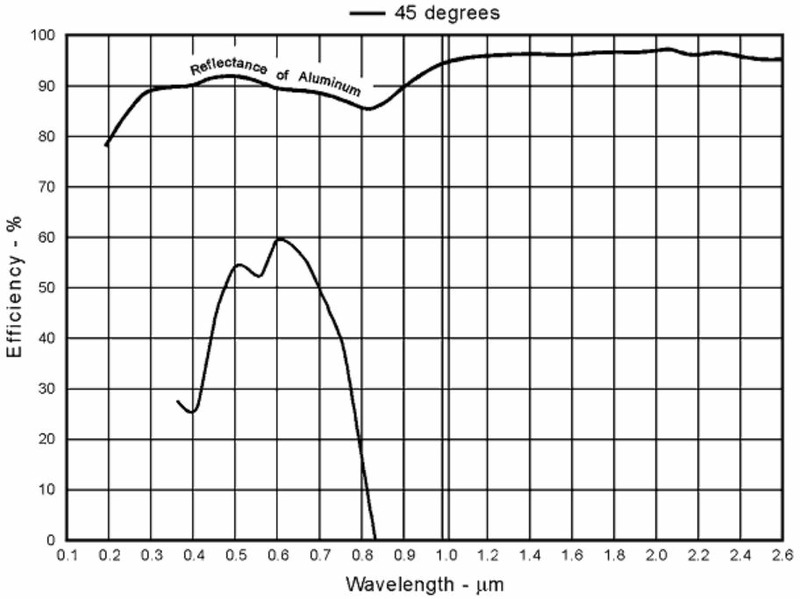
| Master 1113 (default) | Maximum Ruled Area (mm): 154 x 206 | |||
|---|---|---|---|---|
| Coating | Aluminum | Aluminum | Aluminum | Aluminum |
| Spectral Order | m = 1 | m = 1 | m = 2 | m = 2 |
| Polarization(s) | S & P | Unpolarized | S & P | Unpolarized |
| Efficiency | 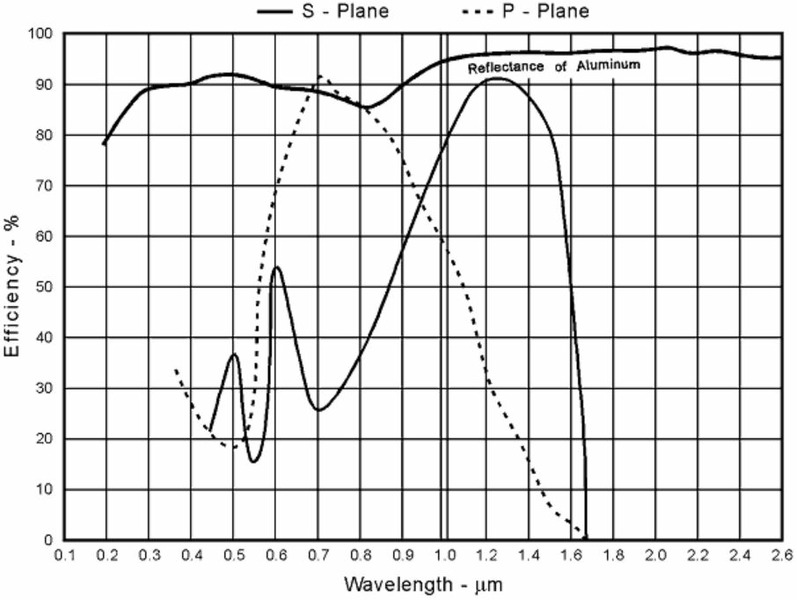 |
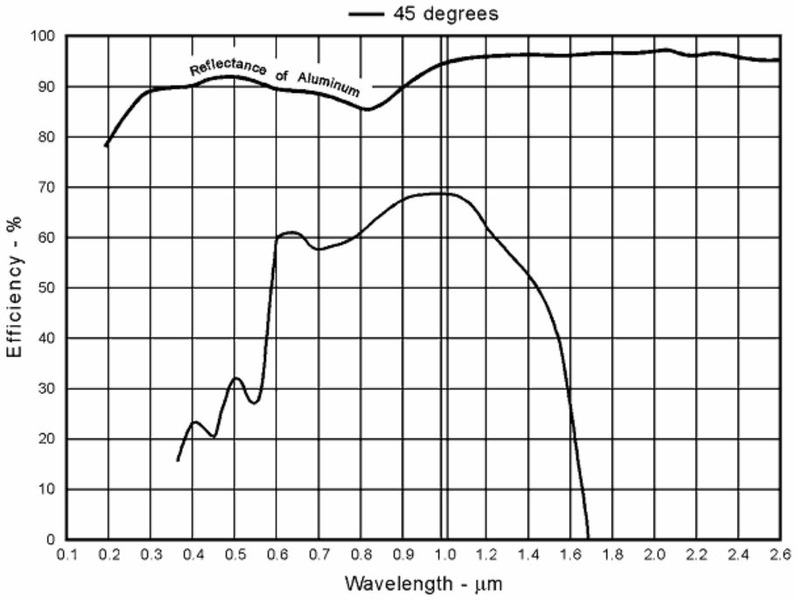 |
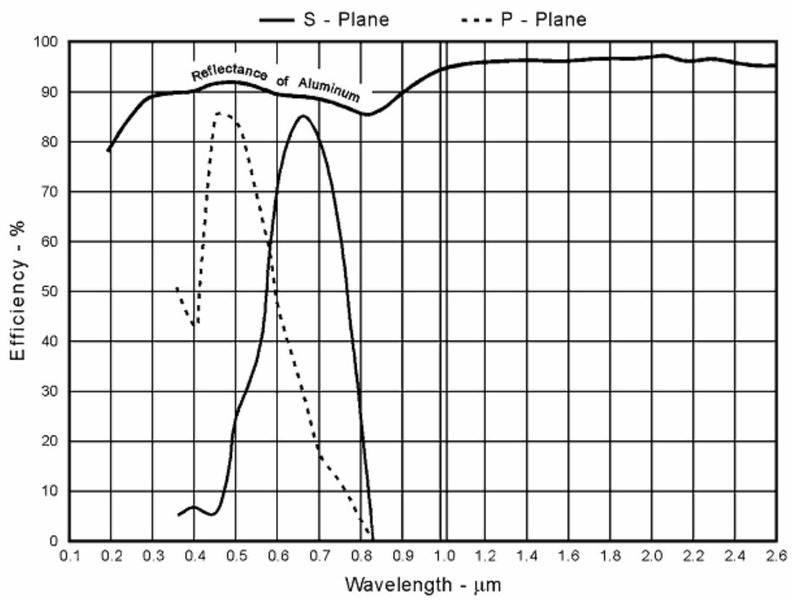 |
 |
| Master 2926 | Maximum Ruled Area (mm): 154 x 206 | |||
| Coating | Aluminum | |||
| Spectral Order | m = 1 | |||
| Polarization(s) | S, P & Average | |||
| Efficiency | 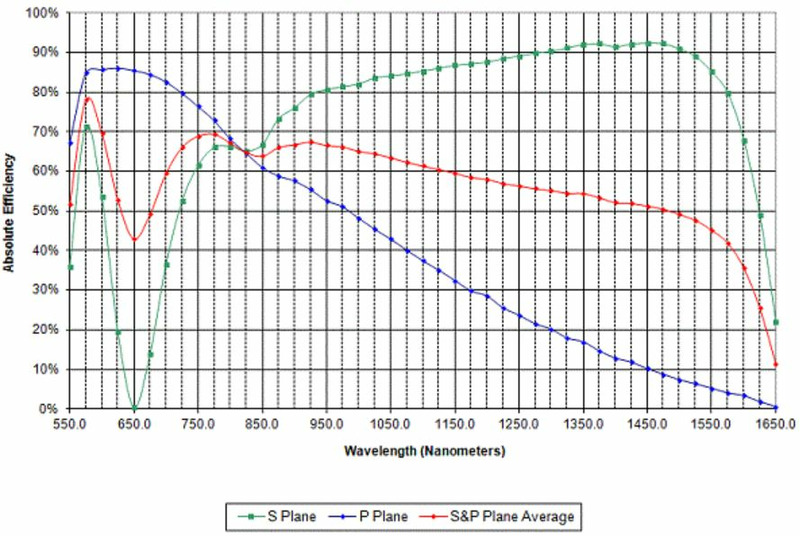 |
|||
| Master 3060 | Maximum Ruled Area (mm): 102 x 102 | |||
| Coating | Aluminum | |||
| Spectral Order | m = 1 | |||
| Polarization(s) | S, P & Average | |||
| Efficiency | 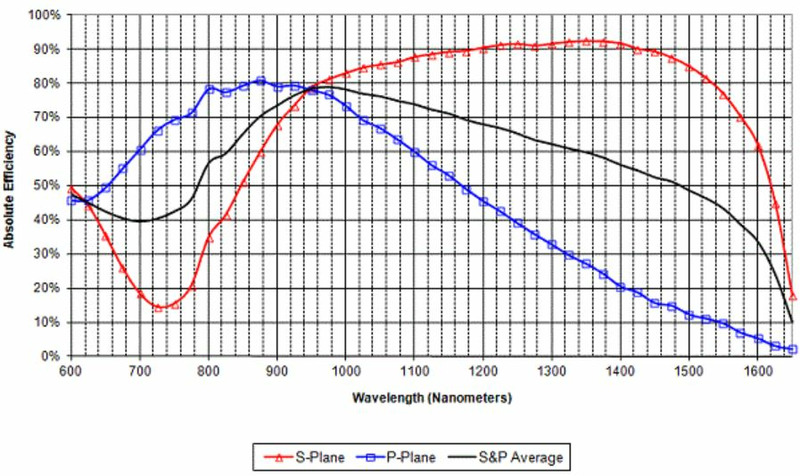 |
|||
Plane Ruled Diffraction Grating Construction
In general, for ruled diffraction gratings the groove spacing determines the diffraction angles, and the groove depth and blaze angle determines how diffracted energy is distributed between diffraction orders. Designed for first order Littrow use, Newport’s Plane Ruled Reflection Gratings are blazed to achieve extremely high single-order diffraction efficiency at particular design wavelengths. At Newport, we have three ruling engines in full-time operation, each producing high-quality master gratings each year. These ruling engines provide gratings with triangular groove profiles, very low Rowland ghosts, and high resolving power. Mechanically ruled, individual grooves are burnished with a diamond tool against a thin coating of evaporated metal. Utilizing a high fidelity cast replication process, developed and enhanced through years of research and manufacturing experience, we have the ability to provide duplicates of master gratings that equal the quality and performance of the master grating.

The Grating Equation

The basic grating equation determines the discrete directions into which monochromatic light of wavelength λ is diffracted. The equation is shown below:
mλ = dG (sinα + sinβm)
The above figure illustrates this diffraction. Light of wavelength λ is incident at an angle α and diffracted by the grating (with a groove spacing dG) along a set of angles βm. These angles are measured from the grating normal, which is shown as the dashed line perpendicular to the grating surface at its center. If βm is on the opposite side of the grating normal from α, its sign is opposite. In the equation, m is the order of diffraction, which is an integer. For the zeroth order (m = 0), α and β0 are equal and opposite, resulting in the light simply being reflected, i.e., no diffraction. The sign convention for m requires that it is positive if the diffracted ray lies to the left (counter-clockwise side) of the zeroth order and negative if it lies to the right (the clockwise side). When a beam of monochromatic light is incident on a grating, the light is simply diffracted from the grating in directions corresponding to m = -2, -1, 0, 1, 2, 3, etc. When a beam of polychromatic light is incident on a grating, then the light is dispersed so that each wavelength satisfies the grating equation as shown in the figure. Usually only the first order, positive or negative, is desired and so higher order wavelengths may need to be blocked. In many monochromators and spectrographs, a constant-deviation mount is used where the wavelength is changed by rotating the grating around an axis while the angle between the incident and diffracted light (or deviation angle) remains unchanged.
Ultrafast Pulse Amplification
Low Rowland Ghosting
Handling Diffraction Gratings
Float Glass Substrate
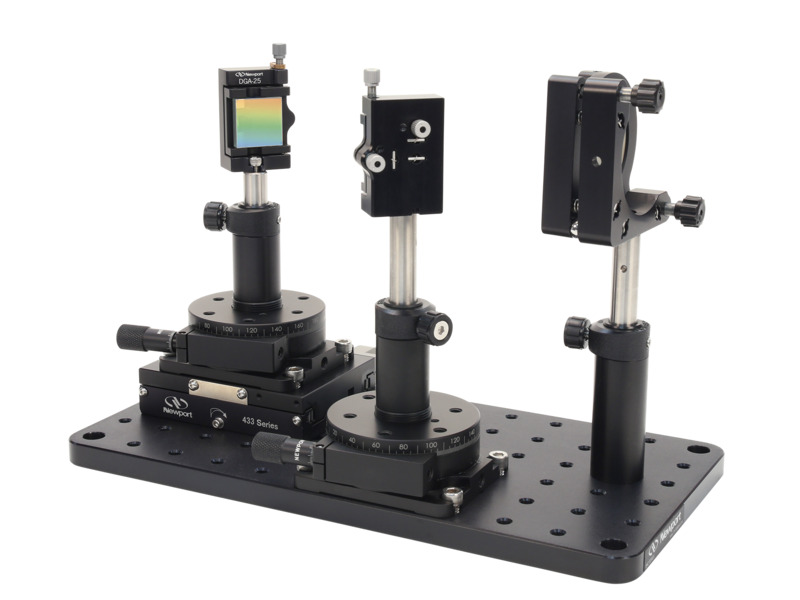
Dual Grating Compressor Setup Example
Two gratings and a mirror are used in the classic Mourou-Strickland setup, to fashion a basic ultrafast beam compressor. Gratings are typically chosen when a large amount of dispersion is required and can be used in higher energy applications because they are reflective. See the parts list of the shown setup example below.
| Part No | Description | Quantity |
| Grating of Your Choice | 2 | |
| Diffraction Grating Mount | 2 | |
| Rotation Stage | 2 | |
| Linear Stage | 1 | |
| 2 in. Silver Mirror | 1 | |
| Mirror Mount | 1 | |
| Optical Post, 2 in. | 1 | |
| Optical Post, 3 in. | 2 | |
| Post Holder, 2 in. | 2 | |
| Post Holder, 3 in. | 1 | |
Custom Diffraction Gratings
Newport is pleased to discuss special and unusual applications that are not addressed by our build to order catalog diffraction gratings. In some instances, none of the hundreds of master gratings we have in stock meet specifications, so a new master may be required. Please see Custom Diffraction Gratings for additional information on our capabilities.
Resources
Selection Guides
Technical Notes
Diffraction Grating Physics Guidelines for Specifying Diffraction Gratings Handling Diffraction Gratings The Blaze Arrow Scattered Light and Stray Light in Diffraction Gratings Determination of the Blaze Wavelength Measurement of Polarization-Dependent Loss for Plane Diffraction Gratings Diffraction Grating Part Number System Master Gratings vs. Replica Gratings(269.6 kB, PDF) The Grating Equation Diffraction Orders