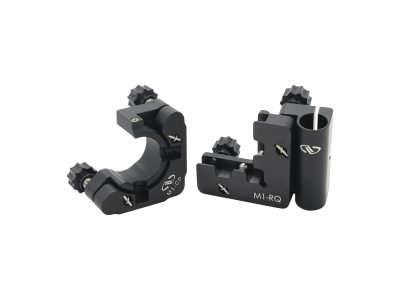
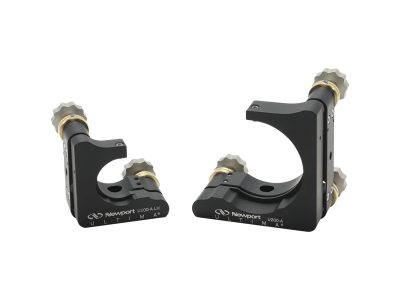
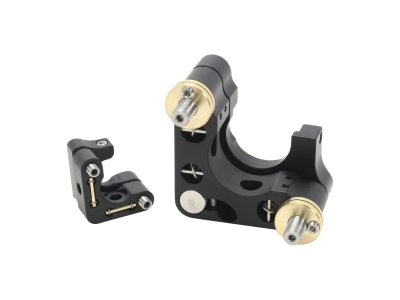
ULTIMA® Clear-Edge Corner Mirror Mounts
ULTIMA® Clear-Edge Corner Mirror Mounts
ULTIMA® clear-edge corner gimbal mirror mounts can tilt an optic without translating its surface by adjusting two adjacent actuators. Placing the center of the optic in the corner, at the intersection of the actuator axes, and adjusting two adjacent actuators an equal amount, results in gimbal-like motion.
- Position optics in tight locations
- Gimbal movement with kinematic stability
- Low friction sapphire pads See All Features
| Compare | Description | Drawings, CAD & Specs | Avail. | Price | ||
|---|---|---|---|---|---|---|
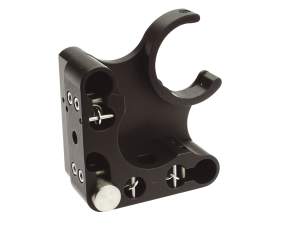 | U100-ACGOptical Mount, Clear Edge, Corner, ULTIMA®, 1.0 in., No Actuators | |||||
 | U100-ACG-2K-NLOptical Mount, Clear Edge, Corner, ULTIMA®, 1.0 in., 2 Knob Adjustment | |||||
 | U100-ACG-3K-NLOptical Mount, Clear Edge, Corner, ULTIMA®, 1.0 in., 3 Knob Adjustment |
Specifications
- MechanismGimbal
- Optic Diameter25.4 mm
- Actuator LocksNo
- Adjustment Screw Thread100 TPI
- Angular Range±5°
- Optic LoadingRear
- MaterialAnodized Aluminum
- Thread Type8-32 (M4) CLR
- Optical Axis Height44.5 mm
Features
Clear Edge Corner Mount
ULTIMA Corner Gimbal mounts have the additional advantage of a clear edge aperture. With the clear edge design, beams can be reflected from one mount to another at smaller incident angles taking less space between the mounts. Clear edge mounts are also ideal for compensating for pulse dispersion effects through multiple reflections on chirped mirrors.

Gimbal or Kinematic Movement
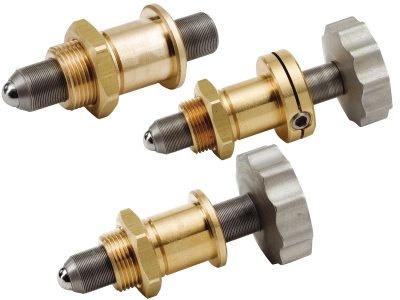
With a corner mount, the center of the mirror is intentionally located at the xy intersection of the pitch and yaw adjusters, i.e., at the virtual fourth point of the square formed by the ball points of the three actuators. To achieve gimbal movement, two adjacent adjustment screws must be actuated the exact same distance. For gimbal pitch adjustment, the adjuster normally used for yaw adjustment must be actuated along with the corner adjuster the exact same distance. For gimbal yaw adjustment, the adjuster normally used for pitch adjustment must be actuated along with the corner adjuster the exact same distance. In this way, the mirror is being rotated about two virtual axes that intersect at the center of the optic, aka gimbal movement. Adjust one actuator at a time and the mount acts as a standard kinematic optical mount. Adjust all three actuators to translate the optic in Z-axis.