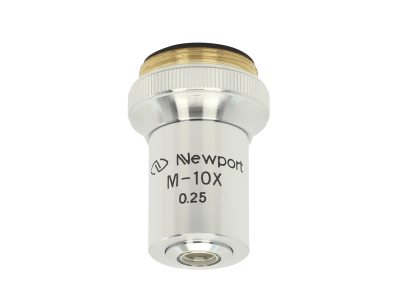
Infinite Conjugate Microscope Objective Lenses
Infinite Conjugate Microscope Objective Lenses
Infinity corrected plan achromatic microscope objectives are ideal for collimating and focusing laser beams in the visible spectrum. High precision optical fabrication and assembly in a class 10,000 cleanroom, make these lenses excellent choices for standard laboratory applications.
- Easily collimate and focus beams
- Infinity corrected objectives
- Great inexpensive general purpose lens
- Visible AR coated See All Features
| Compare | Description | Drawings, CAD & Specs | Avail. | Price | ||
|---|---|---|---|---|---|---|
 | LIO-4XMicroscope Objective Lens, Infinity Corrected, 4x, 0.1 NA, 15.0 mm WD | |||||
 | LIO-10XMicroscope Objective Lens, Infinity Corrected, 10x, 0.25 NA, 10.8 mm WD | |||||
 | LIO-20XMicroscope Objective Lens, Infinity Corrected, 20x, 0.40 NA, 1.5 mm WD | |||||
 | LIO-40XMicroscope Objective Lens, Infinity Corrected, 40x, 0.65 NA, 0.8 mm WD | |||||
 | LIO-60XMicroscope Objective Lens, Infinity Corrected, 60x, 0.85 NA, 0.3 mm WD |
Specifications
Features
Infinity Corrected Objective Lens
Infinity corrected objectives are used in a wide variety of imaging and laser focusing applications. Light rays leaving the objective’s rear aperture are collimated, so that for imaging applications, a secondary lens (usually called a tube lens) is needed in order to focus the collected light from the specimen onto the sensor. The labeled magnification is calculated, assuming the objective is being used with a tube lens of a particular focal length by design. When a tube lens of a different focal length is used, the magnification will need to be adjusted accordingly. As an advantage over finite conjugate objective lenses, a variety of auxiliary optical components, such as optical filters and polarizers can be inserted between the infinity objective lens and the tube lens without altering how the beam propagates and forms the image down the optical path. In laser applications such as optical tweezers and laser cutting, laser beams entering the rear aperture of an infinity objective can be tightly focused to a diffraction-limited spot, providing concentrated optical power and excellent resolution.

Ideal for Focusing and Collimating
Designed for diffraction limited performance across the entire visible spectrum, our LI series objectives allow collimated beams from lasers such as HeNe, Argon, or frequency double Nd:YAG to be focused to a small spot size. Our microscope objectives are broadband AR coated so that maximum about of light will be transmitted.

Spatial Filtering Applications
The LI series of microscope objectives can be used with the 900 series spatial filter system. By selecting an objective and corresponding pinhole, the laser beam can be spatial filtered such that the output beam quality is better. For a tutorial on spatial filters see Spatial Filter Technical Note.

Accessories
Legacy Models on Clearance
RMS Threaded Adapters and Mounts
| Compare | Description | Drawings, CAD & Specs | Avail. | Price | ||
|---|---|---|---|---|---|---|
 | LT10-RMS-NThread Adaptor, 1.0 in. Lens Tubes, 1.035-40 to 0.800-36 RMS Thread | |||||
 | UPA-OMObjective Lens Adapter, RMS Thread, 1 inch Mount | |||||
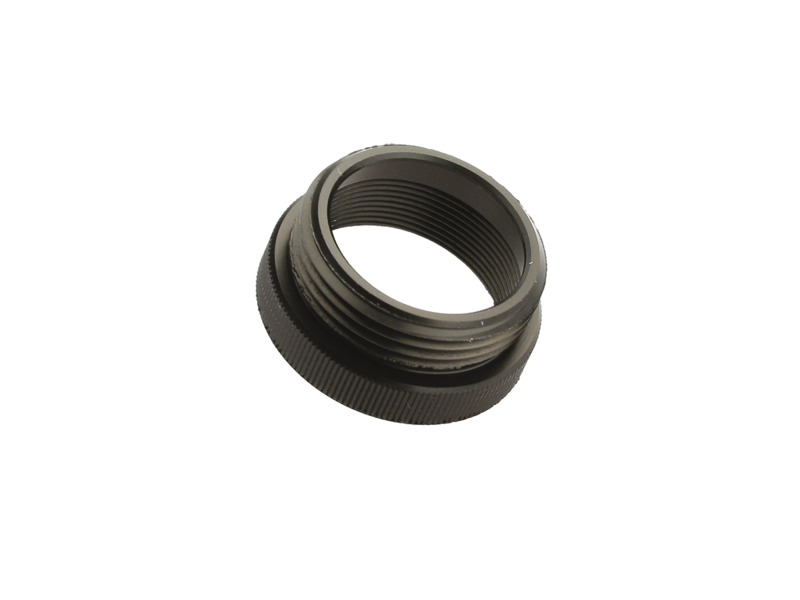 | LPMH-05Objective Lens Holder, RMS, 0.875-20 Thread, For LP-05A Series | |||||
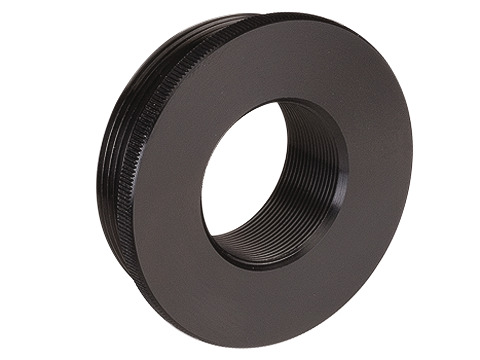 | LPMH-1Objective Lens Holder, RMS, 1.438-20 Thread, For LP-1A Series | |||||
 | 561-OBJObjective Lens Mount, 561 Series | |||||
 | LH-RMSMicroscope Objective Mount, Fixed, A-LINE, 0.800-36 Thread, 8-32 | |||||
 | OC1-RMSObjective Lens Mount, Insertable, RMS Thread, Optics Cage Plus |
Resources
Literature
LIO Microscope Objective Datasheet.pdf(1.2 MB, PDF)