Broadband Beam Samplers
Broadband Beam Samplers
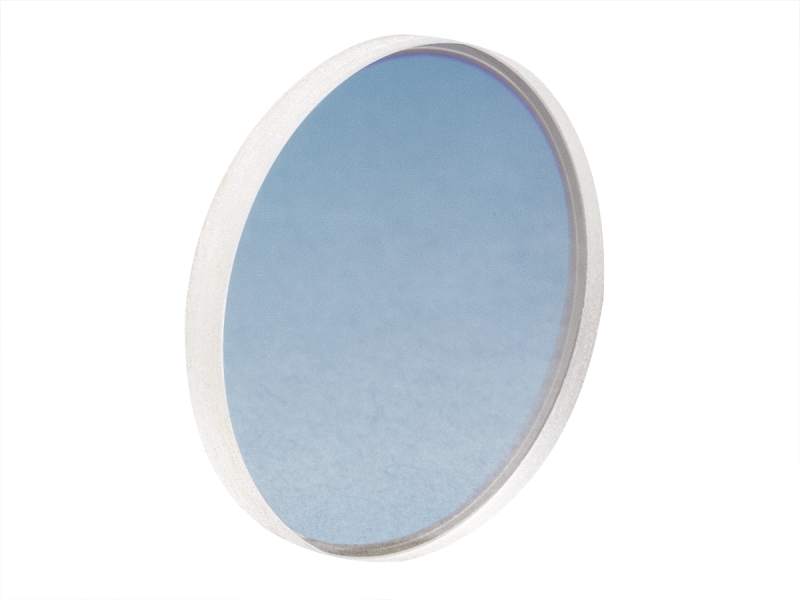
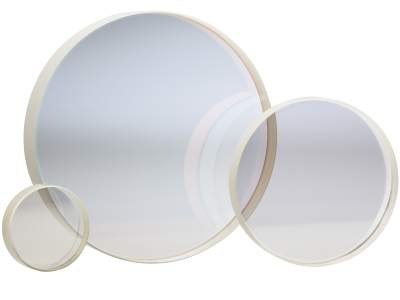
Broadband beam samplers split off, or sample, 1-10% of a beam's energy via Fresnel reflection from a single uncoated surface. This enables beam monitoring with minimal transmitted power loss. The optic's back surface is slightly wedged and AR coated to prevent ghosting.
- Uncoated front surface for beam sampling
- Fresnel reflectance from 1–10% at 45°
- AR coated back surface eliminates ghosting
- Slight wedge virtually eliminates internal fringes
- N-BK7 or UV fused silica substrates See All Features
| Compare | Description | Drawings, CAD & Specs | Avail. | Price | ||
|---|---|---|---|---|---|---|
 | 10B20NC.1 | |||||
| 10B20NC.2 | |||||
| 10B20NC.3 | |||||
| 10Q20NC.1 | |||||
| 10Q20NC.2 | |||||
| 10Q20NC.3 | |||||
| 10Q20NC.UV | |||||
| 10Q40NC.1 | |||||
| 10Q40NC.2 | |||||
| 10Q40NC.3 | |||||
 | 20B20NC.1 | |||||
| 20B20NC.2 | |||||
| 20B20NC.3 | |||||
| 20Q20NC.1 | |||||
| 20Q20NC.2 | |||||
| 20Q20NC.3 | |||||
| 20Q20NC.UV | |||||
| 20Q40NC.1 | |||||
| 20Q40NC.2 | |||||
| 20Q40NC.3 | |||||
| 5801 | |||||
| 5802 |
Specifications
- Angle of Incidence45°
- Damage Threshold500 W/cm2 CW, 1.0 J/cm2 with 10 nsec pulses, typical
- Surface Flatness≤λ/10 at 632.8 nm over the clear aperture
- Diameter Tolerance+0/-0.13 mm
- Wedge30 ±15 arc min
- Clear Aperture> central 80% of diameter
- Chamfers0.25-0.76 mm face width
- Chamfers Angle Tolerance45° ±15°
- DurabilityMIL-C-675C, moderate abrasion million cycles
- Cleaning
Features
Fresnel Reflection
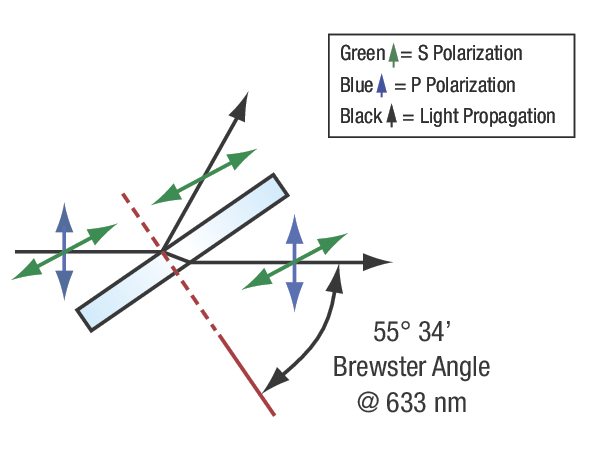
A material that exhibits birefringence, or different refractive indices for different input polarizations, is said to be anisotropic. This anisotropy affects the transmission and absorption properties of light and is the primary mechanism used in polarizers and waveplates. However, even isotropic materials (same index for different polarizations) can enable polarization selection via reflection. For a linearly polarized beam, both S- and P-polarizations exhibit different changes in reflectivity versus incident angle. There is an incident angle known as Brewster’s angle (θB) at which P-polarized light is transmitted without loss, or exhibits zero reflectance, while S-polarized light is partially reflected. This angle can be determined from Snell’s law to be θB = arctan(n2/n1). The accompanying figure shows this response when light is incident from air onto a dielectric material where θB ≈ 56°.
Broadband Beam Samplers
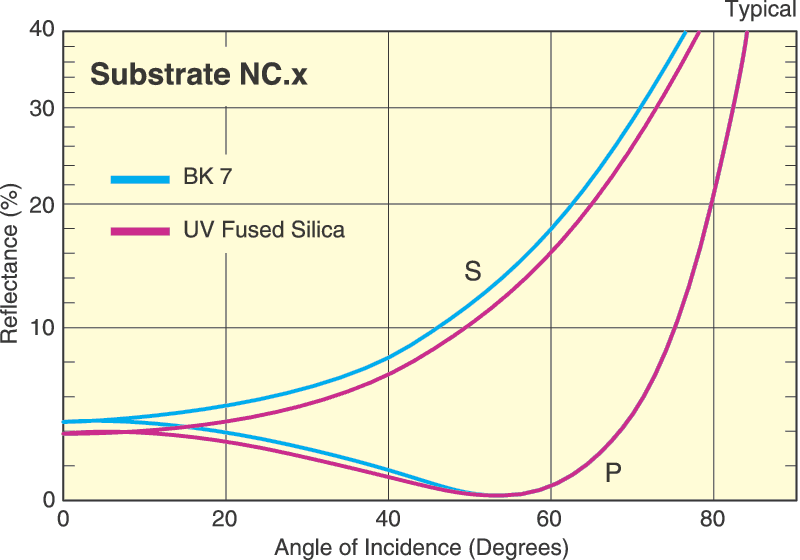
In a beam sampler, the percentage of reflected light is determined by the Fresnel reflection from a single surface. By reflecting approximately 10% of S-polarization and 1% of P-polarization at the nominal 45° AOI, the beam sampler picks off 1-10% of an incident beam, depending on its polarization upon incidence. Reflectance from a single uncoated surface for both S- and P- polarizations is shown here. The graph exhibits reflectance of the plate as a function of incident angle, showing the minimum in the P-polarization at Brewster’s angle, 55° 34’.
N-BK7 Substrates for VIS and NIR Applications
N-BK7 is an excellent lens material for general use such as most visible and near infrared applications. It is the most common borosilicate crown optical glass, and it provides great performance at a good value. Its high homogeneity, low bubble and inclusion content, and straightforward manufacturability make it a good choice for transmissive optics.

UV Fused Silica for UV & Broadband Applications

Slight Wedge Suppresses Unwanted Fringes
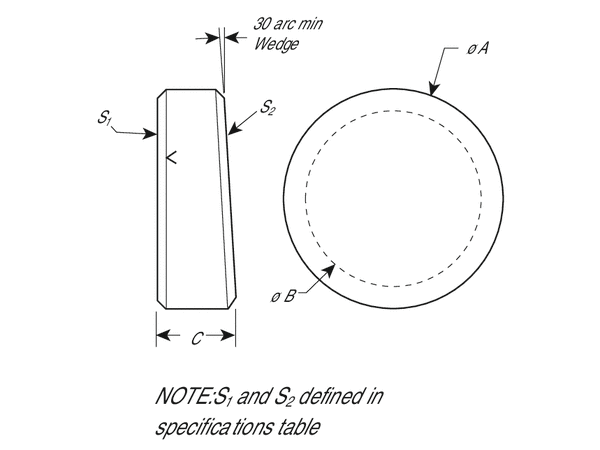
Optics with perfectly parallel faces are unsuited for use as reference elements in laser setups as reflections from both surfaces would be collinear resulting in undesired large period fringes. The introduction of a slight wedge causes unwanted reflections from the second surface to be deflected from the optical path. The back surface (S2) of these beam samplers is slightly wedged. The laser beam should enter the non-wedged surface (S1) where an arrow on the side points to.
AR Coated Back Surface Eliminates Ghosting
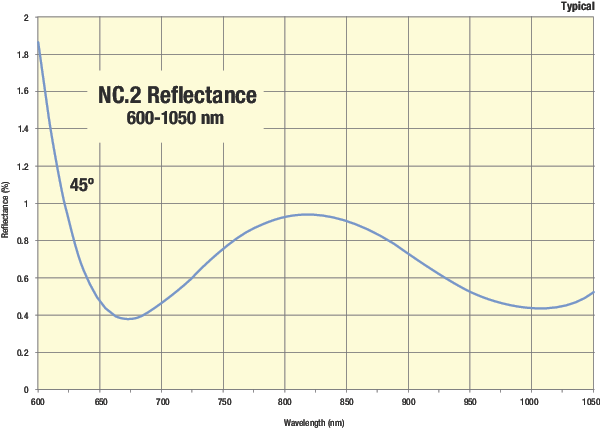
An antireflection coating of high damage threshold (500 W/cm2 CW, 1.0 J/cm2 with 10 nsec pulses, typical) is applied on the back surface (S2) to minimize ghost reflections. Four broadband AR coatings are offered and optimized for 45° angle of incidence beams with <0.75% reflectance. NC.1 covers the 440-700 nm spectral range, NC.2 covers the 660-1000 nm spectral range, NC.3 covers the 1010-1550 nm spectral range and NC.UV covers the 255-440 nm spectral range. Uncoated version is also available, used as beam pick-off optics, to monitor the laser beam, independent of wavelength.
Laser Cavity Applications
Polarization-selective reflectivity is exploited in laser cavities to produce strongly polarized light, as well as for fine tuning of the output laser wavelength. A Brewster’s window is used in the laser cavity, providing polarized light output with minimal power loss. It follows the formula θB = arctan(n), where θB is Brewster’s angle and n is the index of refraction of the material. Often, fixed beam polarization is necessary in order that optical components can consistently perform as they were designed.