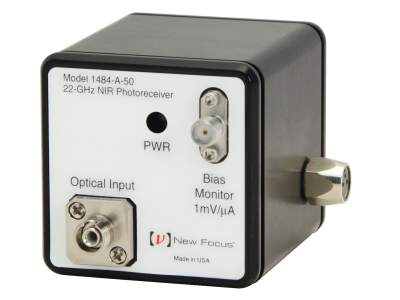
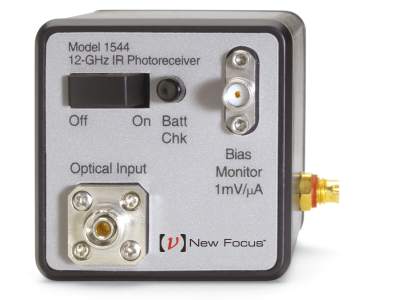
25 GHz Fiber-Optic Detectors
25 GHz Fiber-Optic Detectors
These high speed fiber-optic detectors were designed to offer the ideal combination of high-speed performance up to 25 GHz and optical-input flexibility. They show flat response in both amplitude and phase and are optimized for frequency-domain applications. Every photodetector is individually tested and shipped with its own frequency-response curve.
- Broadband Visible and IR Versions
- Single-mode or multimode FC fiber connectors
- DC to 25 GHz 3 dB bandwidth
- Internal microwave housing See All Features


Specifications
- Detector MaterialInGaAs
- Detector TypeSchottky
- 3 dB BandwidthDC to 25 GHz
- Fiber-Optic ConnectorFC/UPC
- Rise Time14 ps
- Saturation Power2 mW
- Output ConnectorWiltron K
- Output Impedance50 Ω
- DC Bias Monitor Bandwidth50 kHz
- DC Bias Monitor Transimpedance Gain1 V/mA
- Power RequirementsInternal 9-V battery
Features
Smooth Frequency Response
Model 1414 was designed with a smooth frequency response out to 25GHz and is optimized for frequency-domain applications. For time-domain applications, please see our Time Domain Fiber-Optic Detectors.

InGaAs Photodetectors for IR Wavelengths
Model 1414 utilizes an InGaAs Schottky photodiode providing coverage from 500 to 1630 nm for singlemode fiber versions and 850 to 1630 nm for multimode fiber versions.

Internal Microwave Housing

Single-mode or Multi-mode fiber-optic Connectors
Choose from FC single-mode or multimode connectors. With optical-fiber input, the photodiode module can be connected directly to an electronic instrument, eliminating the need for an expensive high-frequency microwave cable. The fiber-coupled input also prevents signal distortion. Multimode versions have 50-µm-core fiber input and an internal GRIN lens for focusing onto the photodetector. In these MM versions, chromatic dispersion of the GRIN lens decreases the usable wavelength range.
Applications
- Characterizing the frequency response of pulsed lasers, modulators and transmitters
- RIN measurements
- Microwave generation - heterodyne experiments

Resources
Technical Notes
Application Notes
Literature
High Speed Optical Receiver and Detector Brochure(3.8 MB, PDF)