22 GHz and 38 GHz Fiber-Optic Receivers
22 GHz and 38 GHz Fiber-Optic Receivers
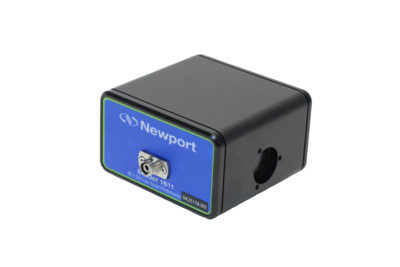
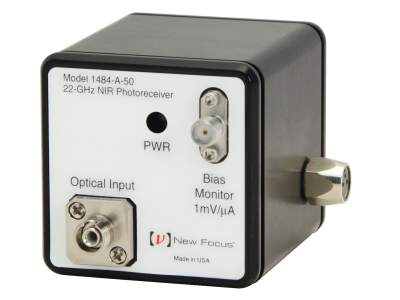
Our 22 and 38 GHz fiber-optic receivers are top of the line high-speed measurement devices for optical waveforms. These photoreceiver modules convert optical signals to ultra-clean electrical signals and can be used to provide every high-speed/high-frequency instrument in your lab an optical input.
- High speed with high dynamic range
- Instrument quality linear photoreceiver in small package
- Low-noise amplifier
- Multimode option available
- Photocurrent monitor
- Protected bias circuitry See All Features
Specifications
- Detector Material1474-A: InGaAs
1484-A-50: GaAs - Detector TypePIN
- Fiber-Optic ConnectorFC/UPC
- Core Diameter1474-A: 9 µm
1484-A-50: 50 µm - Maximum Conversion Gain-65 V/W
- NEP38 pW/√Hz
- Dark Noise590 µVrms
- Saturation Power2 mW
- Output ConnectorAnritsu K
- Output Impedance50 Ω
- DC Bias Monitor Bandwidth15 kHz
- DC Bias Monitor Transimpedance Gain1 V/mA
- DC Bias Monitor OutputSMA
- DC Bias Monitor Output Impedance10k Ω
- Power Requirements±12-15 VDC, 100 mA
- Operating Temperature Range10-35 °C
Features
High Speed and High Dynamic Range
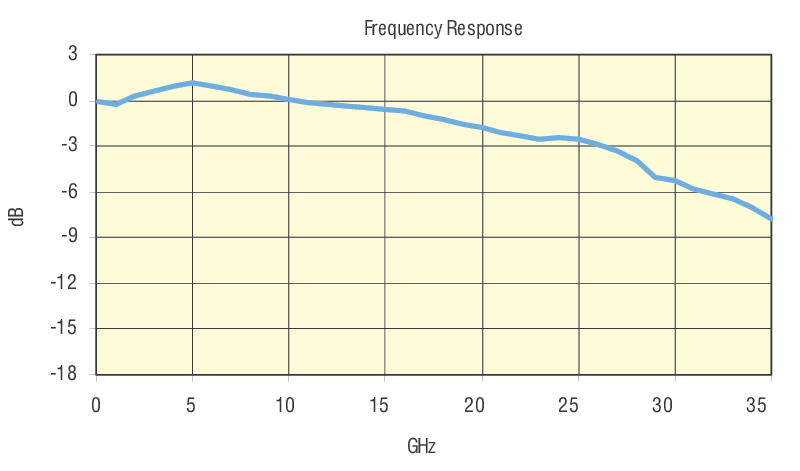
In Model 1474-A an InGaAs PIN photodiode is followed by a low-noise, linear, high-bandwidth amplifier to provide a 38 GHz bandwidth. In Model 1484-A-50 a larger GaAs photodiode is followed by the same amplifier to provide a 22 GHz bandwidth.
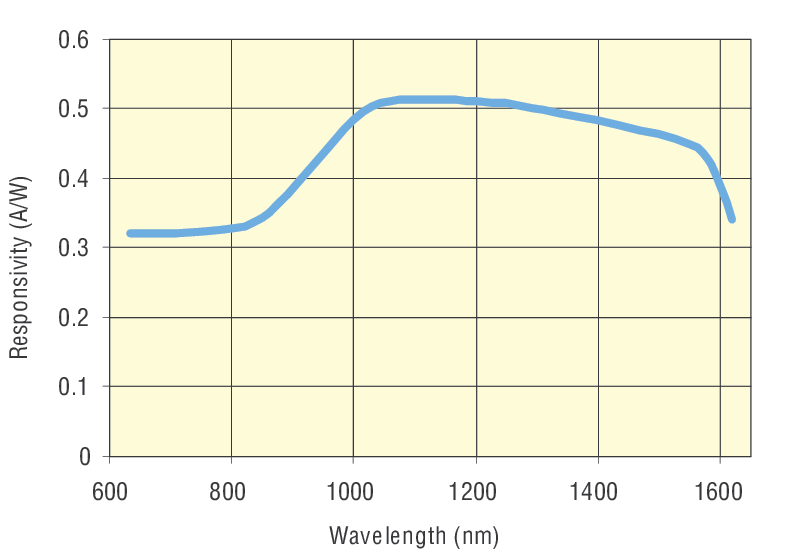
Typical Responsivity of 1474-A
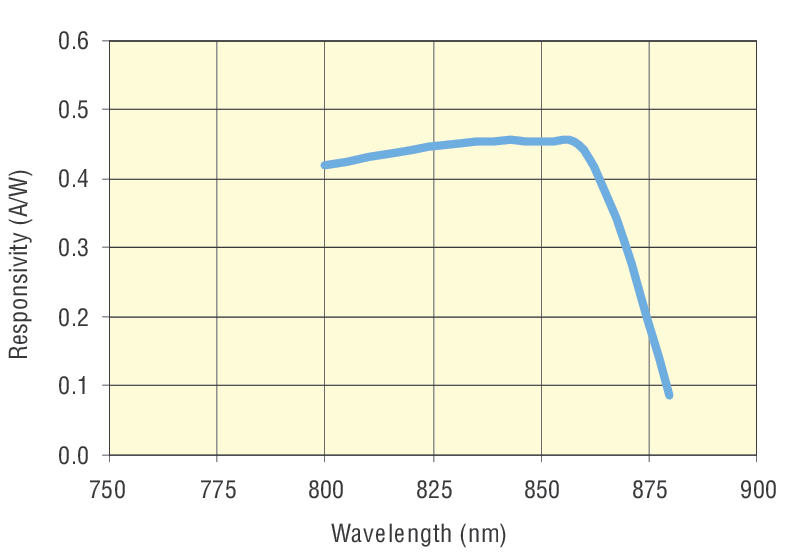
Typical Responsivity of 1484-A-50
Singlemode or Multimode Fiber
In models with single-mode fiber the optical signal is delivered to the PIN photodiode through a 0.1 m, 9-um core optical fiber, while in the Model 1484-A-50 the signal is delivered through a 50-µm core graded-index multimode fiber of the same length. An internal lens in the 1484-A-50 focuses the light onto the small high-speed PIN photodiode.
Model 1474-A Receiver Frequency Response
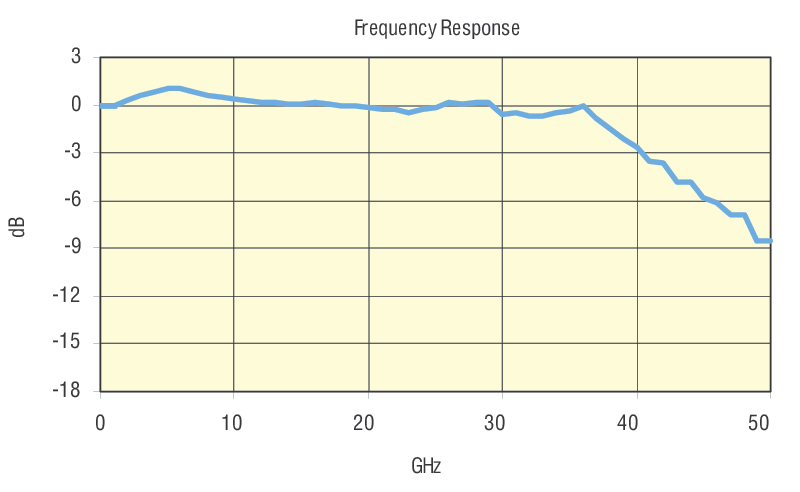
Model 1484-A-50 Receiver Frequency Response
Instrument Quality in a Small Package
The small size of the modules allows you to connect them directly to your test instrument or another high-speed component. This eliminates the need to follow the photoreceiver with coaxial cable, which can distort time-domain waveforms and attenuate CW microwave signals.
Low-Noise Amplifier
The amplifier combines moderate gain and low noise to reduce the input-referred noise floor of your system. It also maintains linearity at high output levels, providing a high dynamic range.