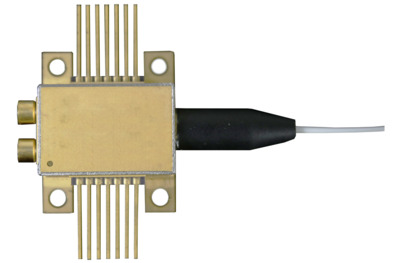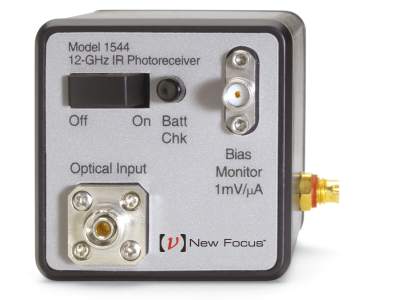
12 GHz Fiber-Optic Receivers
12 GHz Fiber-Optic Receivers
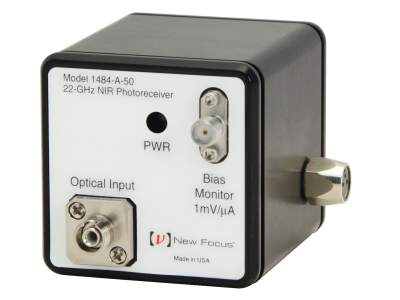
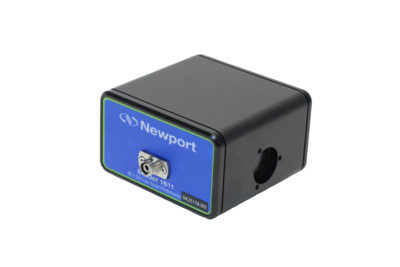
These 12 GHz fiber-optic receivers are ideal for applications that require high sensitivity, high speed, and clean responses. The high gain and gradual, well-behaved roll-off of the frequency response also make them useful for frequency-domain measurements.
- Visible and NIR versions
- Switchable DC-coupled or AC-coupled output versions
- Singlemode and Multimode fiber connector options
- Ultra-clean pulse response
- Ideal for characterizing OC-192 and 10-GbE components See All Features
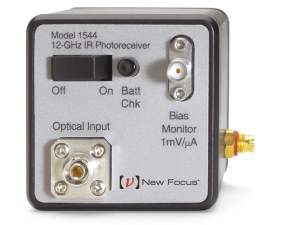
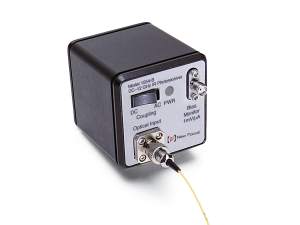
Specifications
- Detector Material1544: InGaAs
1580: GaAs - Detector TypePIN
- Fiber-Optic ConnectorFC/UPC
- Core Diameter1544-x: 9 µm
1544-x-50: 50 µm
1580-x: 62.5 µm - Maximum Transimpedance Gain-1000 V/A
- NEP1544-x: 24 pW/√Hz
1544-x-50: 27 pW/√Hz
1580-x: 42 pW/√Hz - Rise Time32 ps
- Saturation Power0.7 mW
- Output ConnectorWiltron K
- Output Impedance50 Ω
- DC Bias Monitor Bandwidth50 kHz
- DC Bias Monitor Transimpedance Gain1 V/mA
- DC Bias Monitor OutputSMA
- DC Bias Monitor Output Impedance10k Ω
- Power Requirements±15 VDC, 200 mA
Features
GaAs and InGaAs Versions
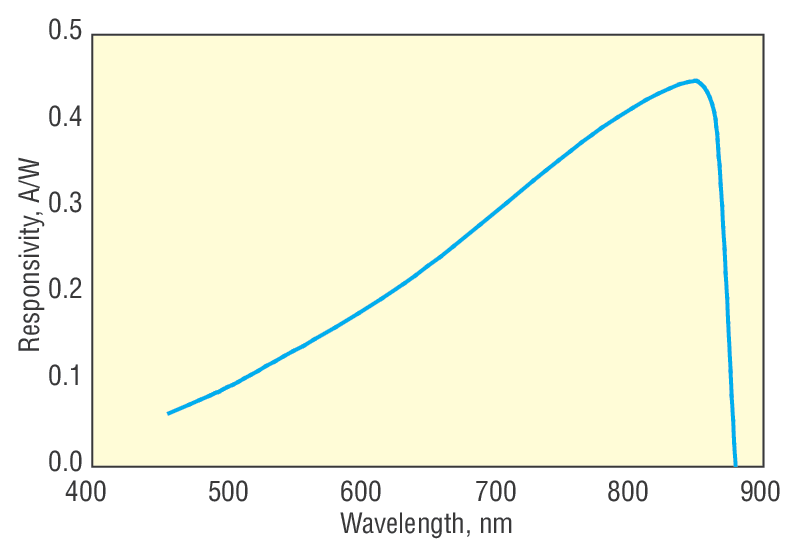
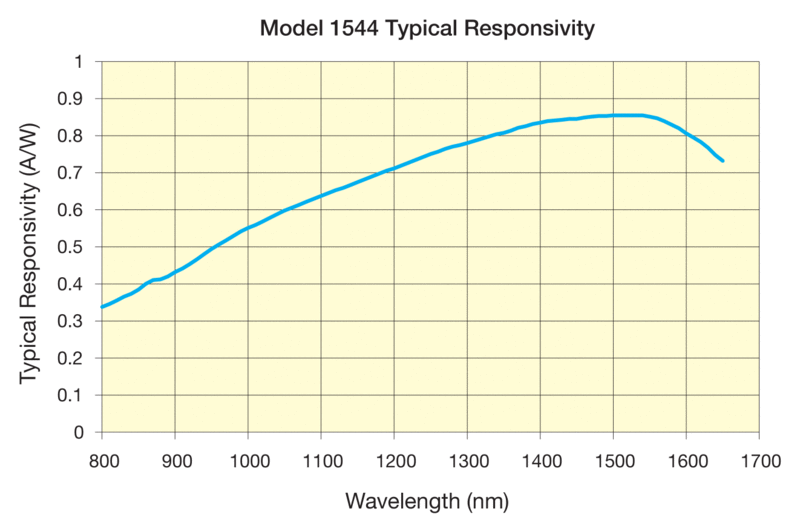
Model 1580-B utilizes a GaAs diode providing wavelength coverage from 780-870 nm, with a higher sensitivity at 850 nm than the 1544 models, popular for datacom, optical sensing, imaging, LIDAR, and time-of-flight measurements. Model 1544 utilizes an InGaAs diode to provide broad spectral coverage from 500-1630 nm for singlemode fiber and 780-1630 nm for multimode fiber.
Typical Responsivity of Model 1580
Typical Responsivity of Model 1544
Switchable DC-Coupled or AC-Coupled Output
The -B versions of these photoreceivers include a DC-coupled option so they give response all the way down to DC. At the touch of a switch, you can select the traditional AC-coupled output with a 10-kHz cutoff or DC-coupled mode.
Ultra-clean Pulse Response
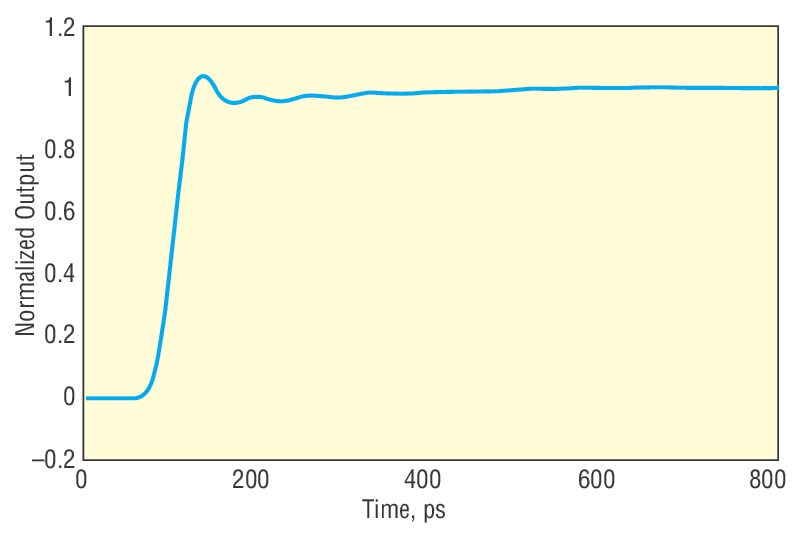
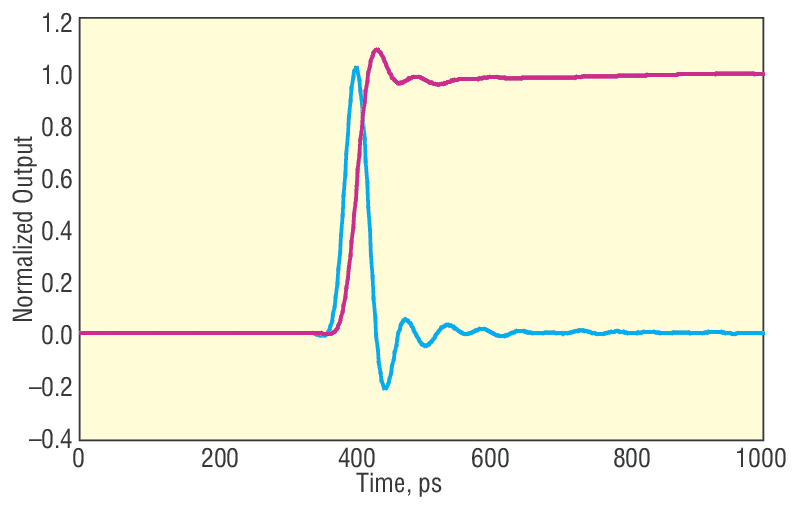
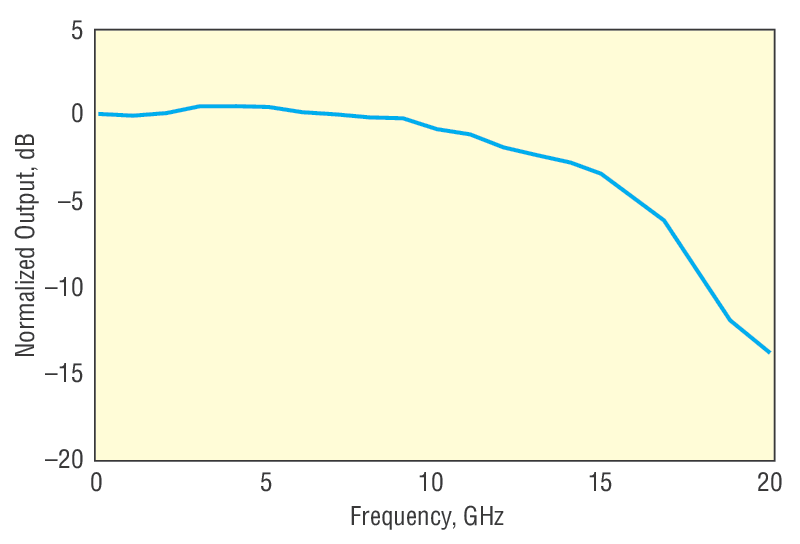
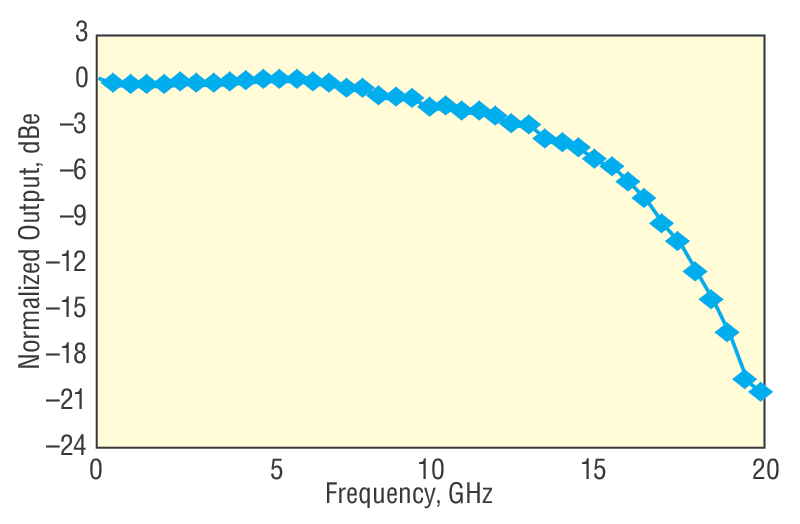
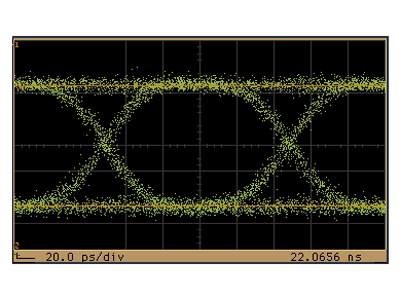
The clean response and 32 ps rise time make these devices especially well-suited for time-domain characterization of 10-Gbit/s components. The high gain and gradual, well-behaved roll-off of the frequency response also make them useful for frequency-domain measurements.
Typical Step Response of Model 1580
Typical Pulse and Step Response of Model 1544
Typical Frequency Response of Model 1580
Typical Frequency Response of Model 1544
Applications
- Characterizing 10-Gbit/s components, including BER testing and generating eye diagrams
- Characterizing the frequency or time responses of pulsed lasers, modulators, and transmitters
- Characterizing pulse propagation through dispersive optical systems
- RIN measurements
- Heterodyne experiments
- Precision timing/triggering
Singlemode or Multimode Fiber
In Model 1544-A/B optical signal is delivered to the PIN photodiode through a 0.1 m, 9-um core singlemode fiber, while Model 1544-A/B-50 has a 50/125-µm multimode fiber and Model 1580-B comes standard with a 62.5/125-µm multimode fiber, which can accept laser light from both the 50 and 62.5 µm core fiber.