Time Domain Fiber-Optic Detectors
Time Domain Fiber-Optic Detectors
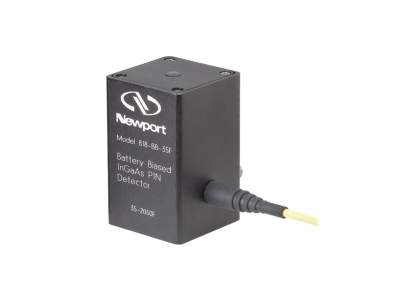
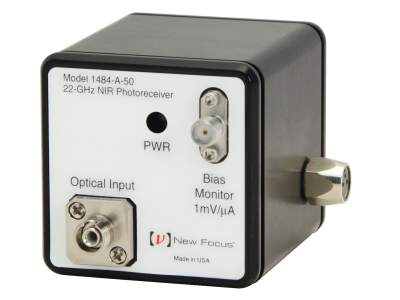
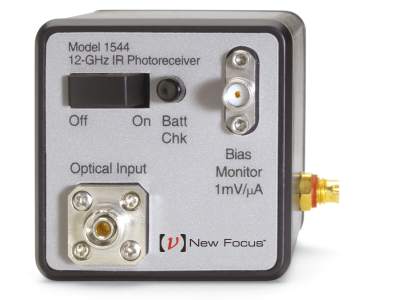
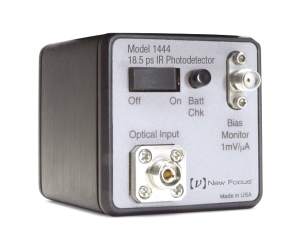
For the ultimate in signal fidelity, the time-domain-optimized ultra high-speed fiber-optic detectors offer 12- and 18.5-ps full-width-at-half-maximum (FWHM) impulse responses. These detectors are ideal for pulse measurements with digital high-speed oscilloscopes, and they can be used in digital communications applications where spurious ringing can degrade eye diagrams and the bit-error-rate (BER) measurement of your system. Each unit is individually tested and shipped with its own pulse- and frequency-response curves.
- Minimal ringing for Time-domain applications
- Ideal for pulsed laser impulse response measurements
- High sensitivity with visible or near-IR input
- Easy-to-use, self-contained module
- Compatible with SDH and SONET filters See All Features

Specifications
- Detector MaterialInGaAs
- Responsivity1024: 0.45 A/W
1444: 0.7 A/W
1444-50: 0.6 A/W - Fiber-Optic ConnectorFC/UPC
- NEP1024: 45 pW/√Hz
1444: 30 pW/√Hz - Saturation Power2 mW
- Output ConnectorAnritsu K
- Output Impedance50 Ω
- DC Bias Monitor Bandwidth50 kHz
- DC Bias Monitor Transimpedance Gain1 V/mA
- Power RequirementsInternal 9-V battery
Features
Minimal Ringing for Time-domain Applications
With clean, fast impulse responses with minimal ringing, these photodetectors are ideal for time-domain applications in high-speed digital fiber-optic communications systems including BER testing, characterizing modulators and other components, and short-pulsed-laser measurements. For frequency-domain applications, please see our 45 GHz or 25 GHz Fiber-Optic Detectors which provide a flat frequency response over wide bandwidths.
Model 1024 Impulse Response

Model 1444 Impulse Response

High Sensitivity to Visible or NIR
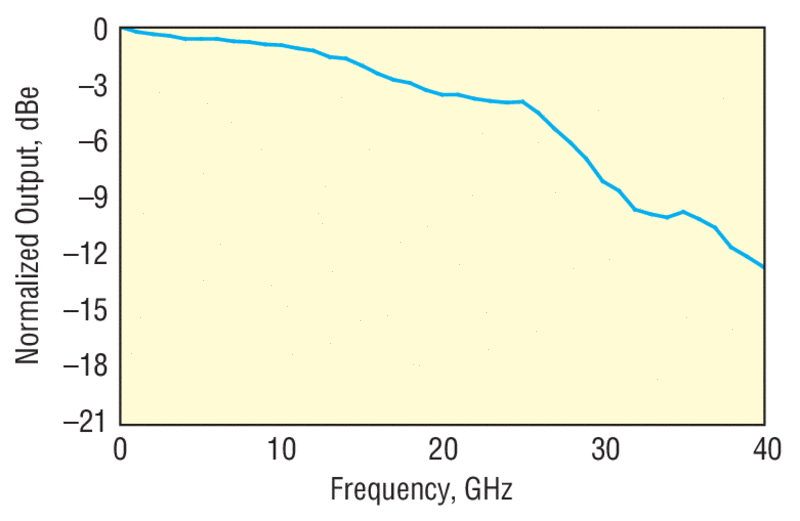
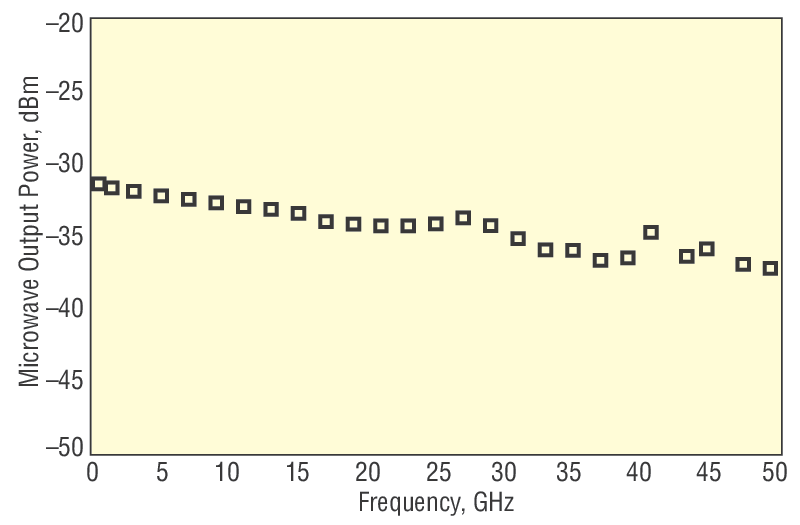
Model 1444 Frequency Response
Model 1024 Responsivity

Model 1444 Responsivity

Model 1024 Frequency Response
Compatible With SDH and SONET Filters
Applications
- Direct temporal proile measurements of nsec pulsed lasers for marking and machining applications
- Characterizing the frequency response of pulsed lasers, modulators & transmitters
- Microwave generation - heterodyne experiments
- Characterizing pulse propagation through dispersive optical systems
Easy-to-use, Self-contained Module
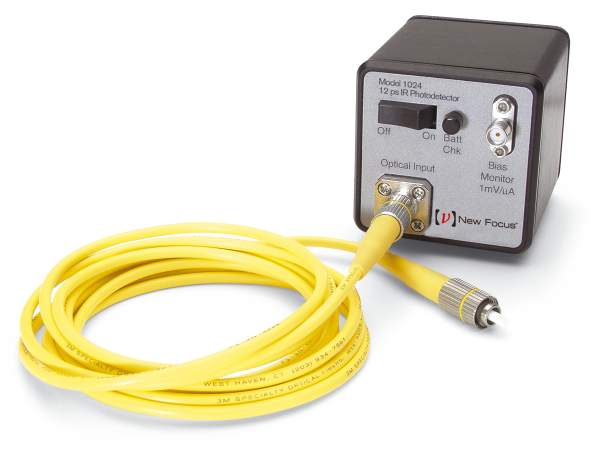
The compact, self-contained packaging of these photodetectors powered by a user-replaceable 9-V battery makes them useful in laboratory investigations of data communications systems. The photodiode bias circuit and battery are built into the RF-shielded case, reducing the risk of damage from excessive voltage or rough handling, and eliminating the need for expensive bias tees. All these photodetectors also come equipped with a DC-bias monitor that has a transimpedance gain of 1 mV/µA in a 50-kHz bandwidth.
Resources
Technical Notes
Application Notes
Literature
High Speed Optical Receiver and Detector Brochure(3.8 MB, PDF)